

AI & Data Fundamentals
What Is an AI Agent? A Complete Guide
What Is an AI Agent?
An AI agent is a software system that uses artificial intelligence to pursue goals and complete tasks on a person's behalf, with a meaningful degree of independence in how it gets there. Unlike a simple automated script, an agent can reason through a problem, plan a sequence of steps, remember relevant context, and adjust its approach as circumstances change.
Much of what makes this possible comes from multimodal generative AI and foundation models. Modern agents can take in text, voice, video, audio, and code all at once, hold a conversation, reason through a decision, and act on it. Over time they can also learn from experience, carry out transactions or business processes, and even coordinate with other agents to handle more complex, multi-step workflows.
Key Features of an AI Agent
The foundation of most agents traces back to the reasoning-plus-acting pattern popularized by the ReAct framework, but the concept has expanded well beyond that core pairing.
- Reasoning. The ability to apply logic to available information in order to draw conclusions, spot patterns, and make informed decisions rather than just following a fixed script.
- Acting. Turning a decision or plan into an actual action, whether that's a physical movement for an embodied system or a digital one, like sending a message, updating a record, or kicking off another process.
- Observing. Perceiving the surrounding environment, whether through computer vision, language understanding, or sensor input, so the agent has an accurate picture of its current context.
- Planning. Mapping out the steps needed to reach a goal, weighing different possible actions, and anticipating obstacles before they happen.
- Collaborating. Coordinating with humans or other agents by communicating clearly and accounting for different perspectives, especially important as tasks get more complex.
- Self-refining. Improving over time by learning from feedback and past outcomes, often through machine learning or other optimization techniques.
AI Agents vs. AI Assistants vs. Bots
These three terms get used interchangeably, but they describe meaningfully different levels of independence.
An AI assistant is a type of agent built into a product to work directly alongside a person, understanding natural language requests and taking action on their behalf, but always under their supervision. The person stays in the driver's seat: the assistant can suggest a next step, but the human makes the final call.
The clearest distinctions come down to three things:
- Autonomy. Agents operate and decide independently; assistants need user direction; bots just follow pre-set rules.
- Complexity. Agents are built for complex, multi-step workflows, while assistants and bots handle simpler, more contained tasks.
- Learning. Agents typically use machine learning to improve over time; assistants may learn a little; bots generally don't learn at all.
How Do AI Agents Work?
Every agent is built around a defined role, personality, communication style, and a clear set of instructions describing what tools it has access to.
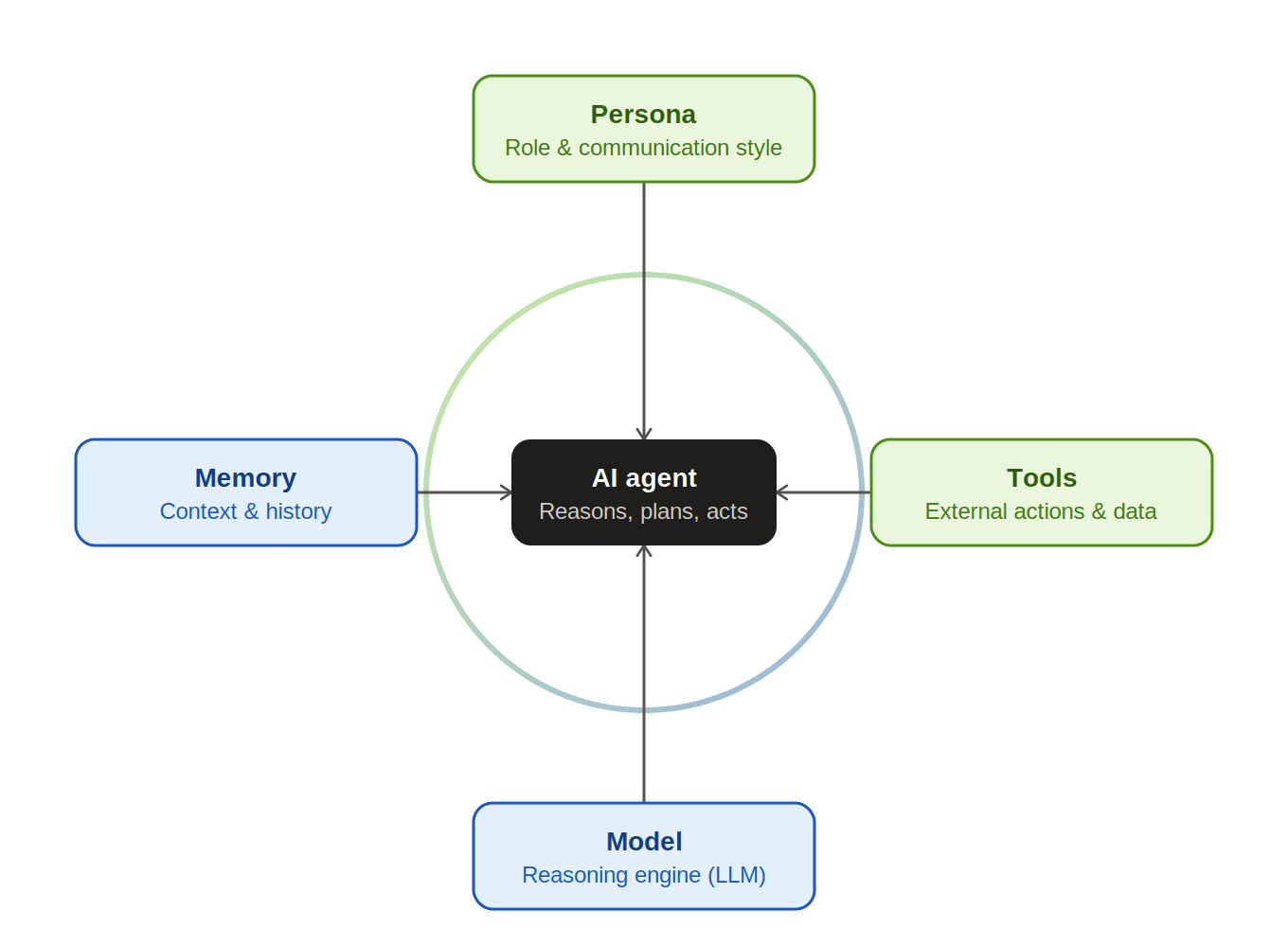
- Persona. A consistent, well-defined character lets an agent behave appropriately for its role, and that persona can evolve as it gains more experience.
- Memory. Agents typically draw on several types of memory at once: short-term memory for the current interaction, long-term memory for historical context, episodic memory for specific past interactions, and consensus memory for information shared across multiple agents. Together, these let an agent stay coherent across a conversation and improve based on what it's seen before.
- Tools. These are the functions or external resources an agent can call on to interact with the world, whether that means looking something up, manipulating data, or controlling another system. Tools can be physical, graphical, or program-based, and part of building a capable agent is teaching it when and how to use each one.
- Model. A large language model typically serves as the agent's core reasoning engine, the part that understands input, works through a problem, and generates a response, while surrounding components handle the actual planning and execution.
Types of AI Agents
Agents get categorized a few different ways depending on what aspect you're looking at.
By How They Interact
- Interactive agents (surface agents). Work directly with people on things like customer support, healthcare, or education. They're typically triggered by a user's query and respond to fulfill a specific request or transaction.
- Background agents. Operate behind the scenes with little to no direct human interaction, automating routine work, surfacing insights from data, and proactively flagging issues. These tend to be triggered by events rather than direct requests.
By Number of Agents Involved
- Single-agent systems. Work independently toward one specific goal, drawing on external tools as needed. They're a good fit for well-defined tasks that don't require input from other agents, and they typically rely on a single underlying model.
- Multi-agent systems. Involve several agents working together, or sometimes competing, toward a shared or individual objective. Each agent can run on a different underlying model suited to its particular role, which makes these systems well suited to simulating more complex, human-like coordination.
Benefits of Using AI Agents
- Efficiency and productivity. Agents can divide up work the way specialized team members would, execute multiple tasks in parallel, and absorb repetitive work so people can focus on higher-value thinking.
- Better decision-making. When agents collaborate, compare notes, and incorporate feedback, they can refine their reasoning, catch errors, and adapt their strategy as situations shift.
- Expanded capabilities. Agents can tackle harder real-world problems by combining their individual strengths, communicate naturally in human language, pull in outside tools and information, and get better over time through experience.
- Social simulation. In multi-agent settings, agents can model realistic social dynamics, like forming working relationships or sharing information, and more complex behavior patterns can emerge naturally from those interactions.
Challenges With AI Agents
- Emotionally complex tasks. Work that requires deep empathy or reading unspoken social cues, like therapy, social work, or conflict resolution, remains a weak spot for current AI systems.
- High-stakes ethical decisions. Agents can act on data, but they don't have the judgment or moral reasoning needed for areas like law enforcement, medical diagnosis, or judicial decisions.
- Unpredictable physical environments. Tasks that demand real-time adaptation and fine motor control, such as surgery or disaster response, are still difficult for agents operating in the physical world.
- Resource demands. Building and running sophisticated agents can be computationally expensive, which may put them out of reach for smaller teams or tighter budgets.
Common Use Cases for AI Agents
Organizations are generally deploying agents across six broad categories:
- Customer agents — deliver personalized support across web, mobile, or in-person channels, answering questions and resolving issues.
- Employee agents — streamline internal processes, handle repetitive work, and assist with content editing or translation.
- Creative agents — support the creative process by generating content, images, and ideas, and assisting with design and campaigns.
- Data agents — surface meaningful insights from complex datasets while maintaining factual accuracy.
- Code agents — accelerate software development through AI-assisted code generation and help teams ramp up on new languages or codebases faster.
- Security agents — strengthen an organization's security posture across prevention, detection, and response.
Frequently Asked Questions
An AI agent operates with a high degree of autonomy, making decisions and taking multi-step action toward a goal with limited human input. An AI assistant works more reactively, responding to a user's requests and recommending actions, but leaving the final decision to the person.
Most agents combine reasoning, acting, observing, planning, collaborating, and self-refining, letting them understand a situation, decide on a course of action, and improve their performance over time.
Yes. Multi-agent systems let several agents, each potentially built on a different underlying model, collaborate or compete toward a shared or individual goal, which is especially useful for complex workflows that benefit from specialized roles.
Agents currently struggle with tasks that require deep emotional intelligence, high-stakes ethical judgment, or real-time adaptation in unpredictable physical environments, along with any application where the computational cost outweighs the benefit.
Turn this insight into your next move.
Tell us what you're building and we'll show you where uCube.ai actually fits — no generic demo, just a straight conversation about your data and your goals.