


Industry Solutions
AI in Healthcare: How Artificial Intelligence Is Transforming Patient Care
What Is AI's Role in Healthcare?
AI is changing healthcare on three fronts. It eases the admin burden, sharpens diagnosis, and reshapes how care reaches patients. This is no longer a future possibility. McKinsey finds US healthcare well past the experiment stage with generative AI. Agentic AI is now the next source of value.
AI in healthcare means machine learning, natural language processing, and predictive analytics applied to real work. That work includes clinical notes, diagnostic support, the revenue cycle, and staffing. None of it replaces clinicians. It strips friction out of manual workflows that drain time and cause burnout, which gives that time back to patients.
Why Healthcare Is a Strong Fit for AI
Health systems generate enormous volumes of data: clinical notes, imaging, lab results, claims, admin records. Most of it has been hard to use, because it sits in disconnected systems. AI changes that by connecting previously siloed information and surfacing insights that support faster, better informed decisions.
McKinsey's 2026 outlook on US healthcare describes AI-enabled transformation as having moved beyond experimental pilots to become essential infrastructure for efficiency. The report finds AI landing where it matters most. Prior authorization, the revenue cycle, staffing, and supply chain all qualify. Each is a workflow that has strained efficiency and morale for years.
Why AI Adoption Is Accelerating Now
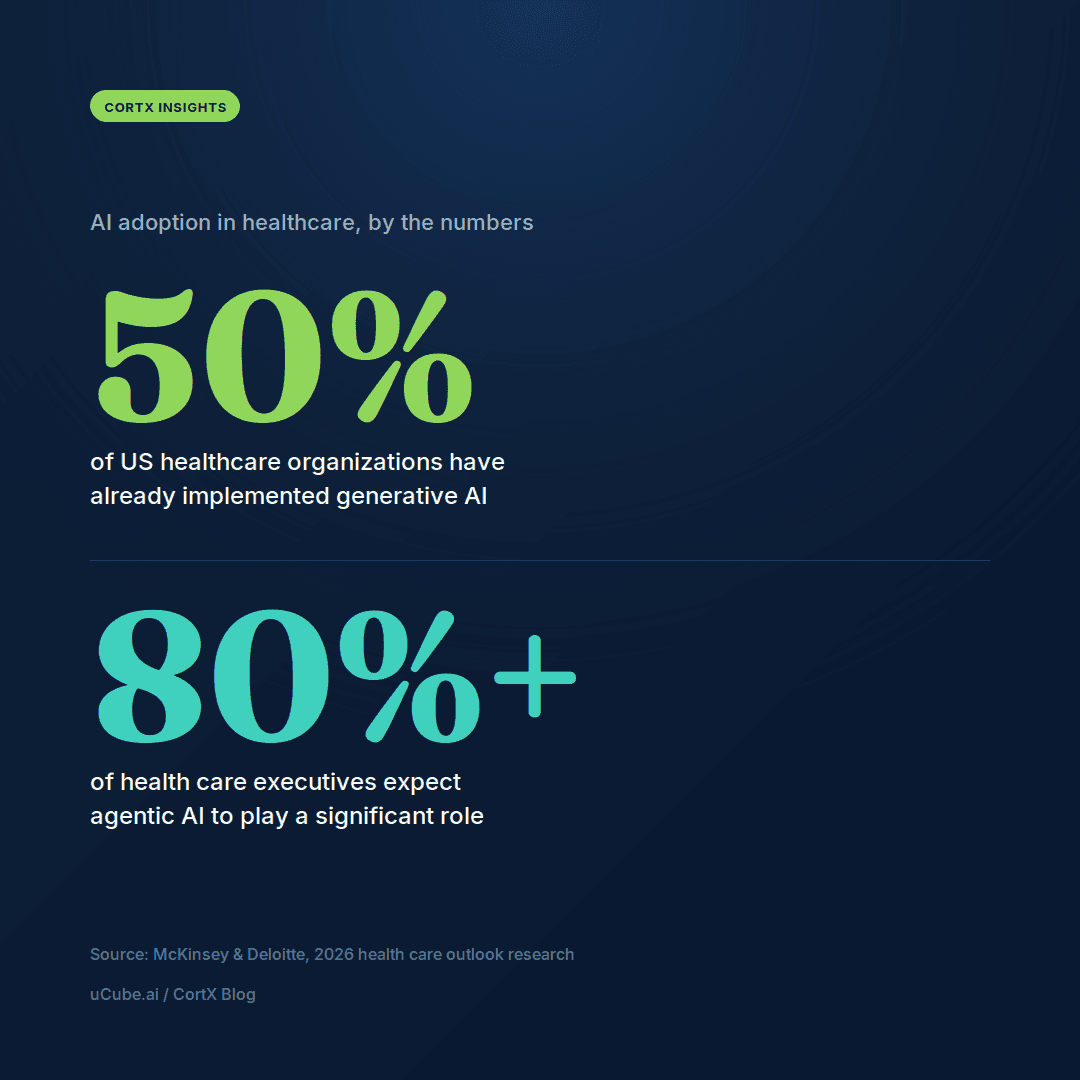
McKinsey finds about half of US healthcare companies have already deployed generative AI. The question has moved on from adoption. It is now integration, measurable return, and the rise of agentic AI. This marks a clear transition from AI as an experiment to AI as an operational expectation.
Deloitte's 2026 US Health Care Outlook Survey points the same way. More than 80 percent of executives expect both agentic and generative AI to matter to their organization. This level of executive expectation signals that AI investment decisions are increasingly being treated as core strategy rather than optional innovation spending.
Policy is moving too. The World Health Organization surveyed 50 member states in its European Region. AI is already reshaping how care is planned, delivered, and governed there. Countries are writing national strategies, governance models, and legal frameworks to keep adoption responsible.
AI Use Cases in Healthcare: A Deeper Look
AI is already at work across healthcare. That runs from the exam room to the back office.
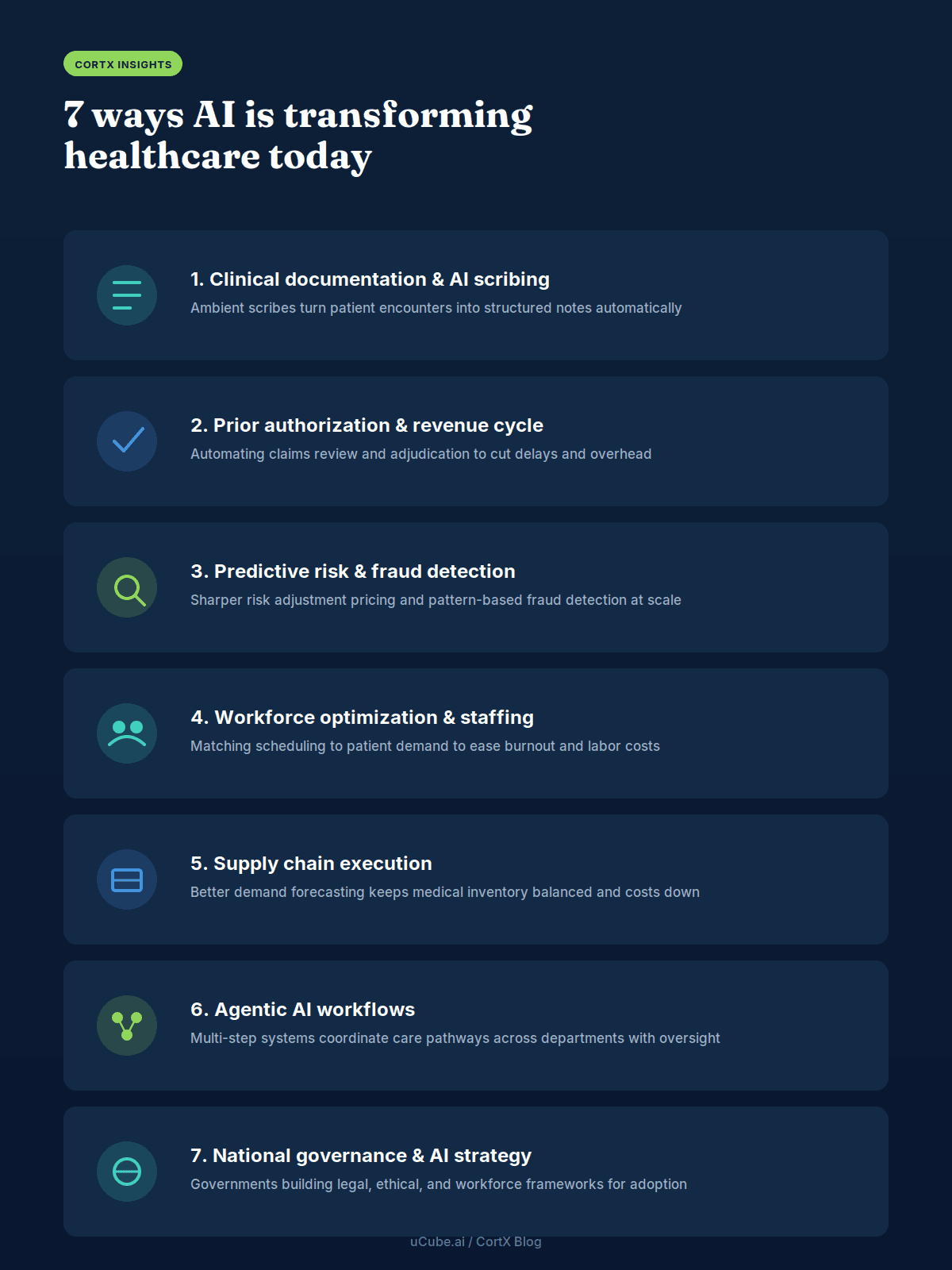
1. Clinical Documentation and AI Scribing
Clinicians lose a large part of the day to documentation. The hours run well past patient-facing time, and burnout follows. AI scribing tools listen to the encounter and write the structured note. That takes most of the documentation load off physicians and nurses.
McKinsey names AI-assisted scribing as a lever for financial and operational stability. The reason is simple: clinician time moves from paperwork back to patients.
2. Prior Authorization and Revenue Cycle Automation
Prior authorization is one of the most friction-heavy processes in healthcare. Manual review and back-and-forth between provider and payer hold care up. AI can automate much of that workflow, and claims adjudication with it. Delays and admin overhead drop on both sides.
McKinsey singles out prior authorization and the revenue cycle. In both, AI is already stripping friction out of manual work rather than sitting in a slide deck.
3. Predictive Modelling for Risk Adjustment and Fraud Detection
Payers face constant pressure to accurately price risk and detect fraudulent claims before they result in financial losses. Predictive models make risk adjustment more accurate. Machine learning also catches fraud patterns and tunes backend claims work that no team could monitor by hand at scale.
This matters more each year. McKinsey expects payer margin recovery beyond 2027 to lean on AI-enabled backend change, new care models, and sharper pricing.
4. Workforce Optimization and Staffing
Healthcare companies face persistent staffing challenges, from nurse scheduling to matching clinical capacity with patient demand across departments. AI reads past patient volumes and staff availability, then proposes a better roster. That cuts both understaffing risk and needless labor cost.
McKinsey lists staffing beside prior authorization and supply chain. All three are delivering real operational value in US health systems today.
5. Supply Chain Execution
Hospitals run complex supply chains: devices, pharmaceuticals, consumables. A shortage or a pile of overstock hits both patient care and cost. AI can improve demand forecasting and procurement decisions across these supply chains, helping healthcare companies maintain adequate inventory while controlling costs.
This fits a pattern in McKinsey's research. The wins are in backbone operations that never make headlines but move cost and care.
6. Agentic AI for Multi-Step Clinical and Administrative Workflows
The next phase moves past single-task automation into agentic systems. These handle multi-step workflows under human oversight, such as coordinating one patient's pathway across several departments. Deloitte's 2026 survey found more than 80 percent of executives expect agentic AI to matter in their organization. That is a clear shift in how the industry reads the near term.
McKinsey describes the same shift as a move away from point solutions. What replaces them is a modular architecture, built on domain-specific models, intelligent agents, and stronger data governance.
7. National Health System Governance and AI Strategy
Beyond individual hospitals and payers, AI is reshaping how entire health systems plan and govern care at a national level. The World Health Organization surveyed 50 member states across its European Region. Countries are building national AI strategies, governance models, and legal and ethical frameworks. Workforce readiness programs sit alongside them.
The message is that adoption cannot be left to individual institutions. Ethical, people-centered outcomes at scale need coordinated policy.
Challenges and Risks of AI in Healthcare
Every credible discussion of healthcare AI needs to address its limitations. A few risks are worth planning for before adoption.
- Trust and clinical-grade accuracy. McKinsey expects the winning vendors to prove clinical-grade accuracy, easy integration, and measurable outcomes. Those that cannot will be pushed to the margins.
- Interoperability. Healthcare companies need solutions that integrate seamlessly with existing workflows rather than creating additional disconnected systems.
- Governance and workforce readiness. These carry real weight at policy level. The WHO stresses legal, ethical, and workforce frameworks for exactly this reason.
- Measurable return on investment. ROI is now a requirement, not a bonus. The industry has moved from adopting generative AI to proving what it returns.
How Healthcare Organizations Should Approach AI Adoption
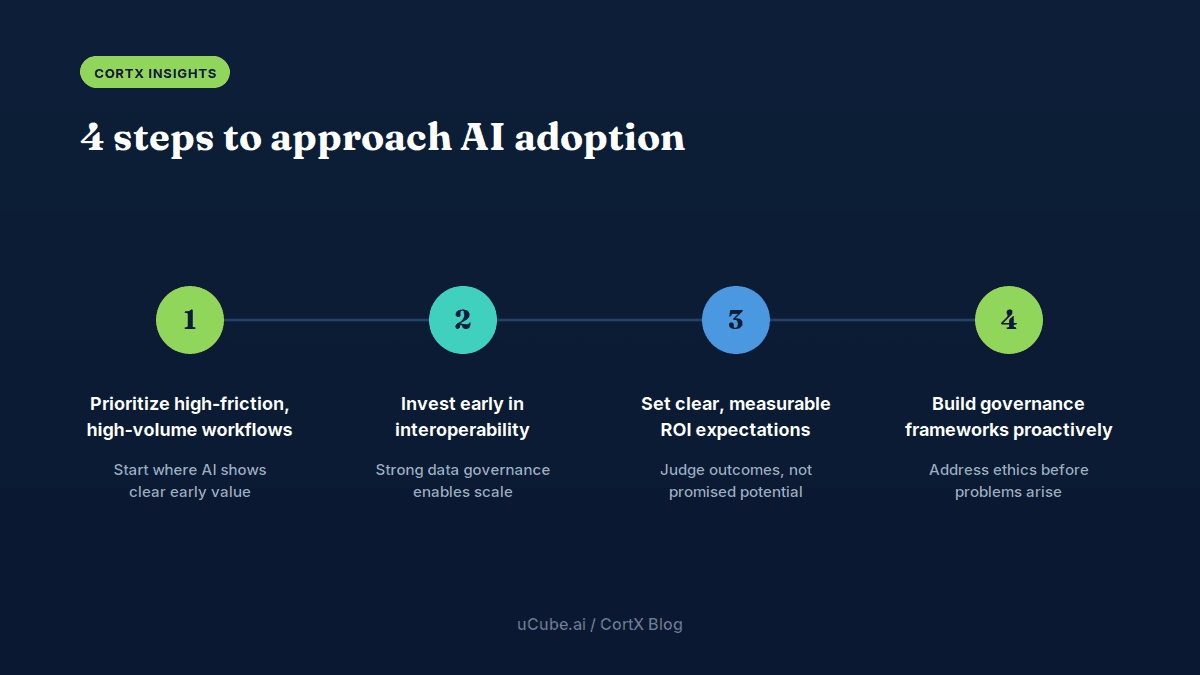
Healthcare companies do not need to adopt AI across every function at once. A more effective approach follows four steps drawn from current industry guidance.
- Prioritize high-friction workflows. Start where the friction is highest and the volume is largest. Prior authorization and clinical documentation both show value early.
- Invest in interoperability and data governance early. McKinsey's research on modular AI architecture emphasizes that scalable innovation depends on strong data foundations rather than isolated point solutions.
- Set clear expectations for measurable outcomes. Vendors and internal initiatives alike are increasingly judged on demonstrable clinical and financial results rather than promised potential.
- Build governance frameworks proactively. Follow the national health systems in the WHO's European Region survey. They settle legal and ethical questions first, not after something goes wrong.
What Does the Future of AI in Healthcare Look Like?
Healthcare is moving toward a model where AI is treated as essential infrastructure rather than an experimental add-on. McKinsey expects healthcare AI to leave scattered point solutions behind. What follows is modular architecture: domain-specific models, intelligent agents, and solid data governance.
Deloitte found more than 80 percent of executives expect agentic AI to matter. That puts the shift at leadership level already, not in isolated pilots. The WHO's policy work runs in parallel. Governments and health systems want this change to happen inside coherent, ethical, people-centered frameworks.
Key Takeaways
- AI is already active in clinical documentation, prior authorization, revenue cycle management, workforce optimization, and supply chain execution across healthcare.
- About half of US healthcare companies have deployed generative AI, per McKinsey. Attention has moved to agentic AI and measurable ROI.
- Deloitte finds more than 80 percent of health care executives expect agentic AI to play a significant role in their companies.
- The WHO surveyed 50 member states in its European Region. Governments there are actively building national AI governance for health care.
- Healthcare companies that prioritize interoperability and measurable outcomes are best positioned to scale AI successfully.
Frequently Asked Questions
AI in healthcare is primarily used for clinical documentation, prior authorization automation, revenue cycle management, predictive risk modelling, workforce optimization, and supply chain execution.
AI assisted clinical scribing tools can automatically generate structured notes from patient encounters, reducing the documentation burden that contributes sharply to physician and nurse burnout.
Yes. McKinsey research shows about half of US healthcare companies have implemented generative AI, and Deloitte finds more than 80 percent of executives expect agentic AI to play a significant role going forward.
No. AI is designed to remove friction from administrative and operational workflows, freeing up clinician time for direct patient care rather than replacing clinical judgment or decision making.
Agentic AI refers to systems capable of handling multi step clinical or administrative workflows with human oversight, such as coordinating a patient's care pathway across multiple departments, representing a step beyond single task automation.
Regulation varies by country, but the World Health Organization's European Region survey found that governments are actively developing national AI strategies, governance models, and legal and ethical frameworks to guide responsible adoption in health care.
Turn this insight into your next move.
Tell us what you're building and we'll show you where uCube.ai actually fits — no generic demo, just a straight conversation about your data and your goals.