


Industry Solutions
AI in Law: How Artificial Intelligence Is Transforming the Legal Industry

What Is AI's Role in the Legal Industry?
Artificial intelligence is reshaping the legal industry by automating research, contract review, and document heavy workflows, allowing lawyers to focus more on judgment, strategy, and client outcomes. This shift is already visible across major legal markets, including India and the UAE, where courts, ministries, and law firms are actively integrating AI into legal processes.
AI in the legal industry refers to the use of machine learning and natural language processing to support tasks such as legal research, contract analysis, document review, and case summarization. Rather than replacing lawyers, AI accelerates repetitive, text heavy work so legal professionals can focus on interpretation, negotiation, and advisory work.
AI in India's Legal Ecosystem
India's legal system faces high case volumes, multilingual documentation, and long turnaround times, all of which make it a strong candidate for AI driven efficiency. Government reporting shows AI is already being explored in courts for translation, case summarization, and workflow efficiency.
Key applications in India include:
- Legal research and precedent discovery
- Case summarization and document organization
- Multilingual translation for regional and national courts
- Workflow automation to reduce administrative backlog
AI does not remove the lawyer from the process. It gives legal teams a faster starting point, so more time goes into strategic and client facing work.
AI in the UAE's Legal and Justice Sector
The UAE has made AI a national priority across government and judicial services, creating strong momentum for legal sector adoption. AI powered tools are already used for legal consultations, document handling, and digital service delivery within the justice system.
For UAE law firms, this means faster response times for cross border and regulatory matters, better handling of multilingual legal content, and more consistent, reviewable workflows across teams. The UAE's legal environment rewards speed and precision, two areas where AI delivers immediate, measurable value.
Why Legal Work Is Fundamentally Changing
Legal work depends on reading, comparing, and reasoning across large volumes of text, making it one of the most natural industries for AI adoption. Two waves of transformation are underway.
| Wave | Impact |
|---|---|
| Efficiency | Faster research, contract review, and document summarization |
| Consistency | Standardized quality control across matters and teams |
AI Use Cases in Legal Practice: A Deeper Look
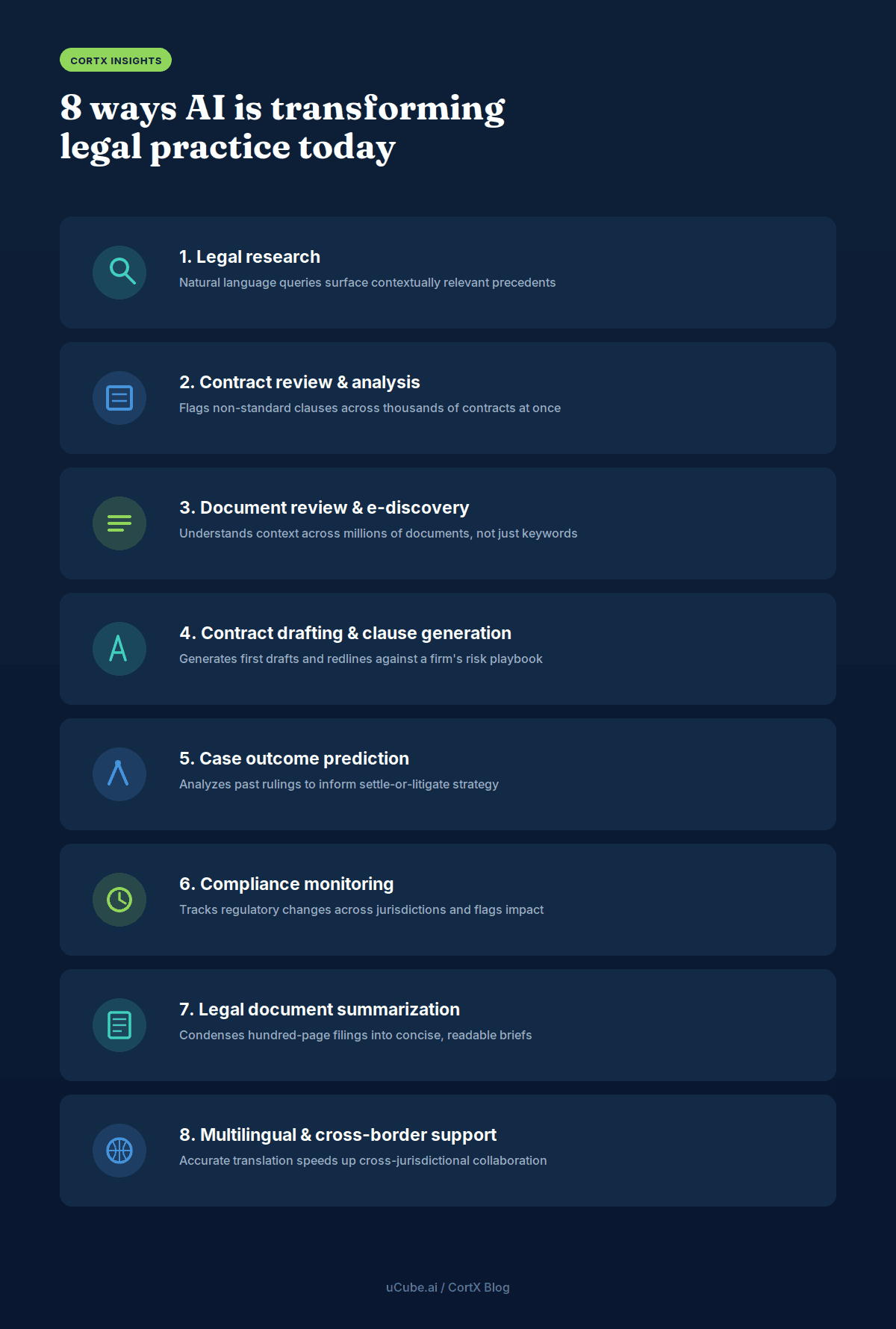
AI is already reshaping a wide range of tasks across legal practice, from research and drafting to litigation strategy and compliance.
1. Legal Research
Traditional legal research relies on keyword searches through case law databases, often returning hundreds of loosely relevant results that a lawyer must manually filter. AI powered research tools use natural language processing to understand the intent behind a query, not just the words in it, surfacing precedents and statutes that are contextually relevant rather than just textually similar.
For example, instead of searching for the phrase "breach of contract delivery delay," a lawyer can ask "cases where courts ruled on liability for delayed delivery due to third party logistics failure" and get ranked, relevant results. This reduces research time from hours to minutes and helps junior associates find stronger precedents faster, without needing years of database search expertise.
2. Contract Review and Analysis
Contract review is one of the most time intensive tasks in corporate law, especially during M&A due diligence, vendor negotiations, or lease agreements. AI systems can scan thousands of contracts simultaneously, flagging non standard clauses, missing indemnification language, unusual termination terms, or deviations from a firm's playbook.
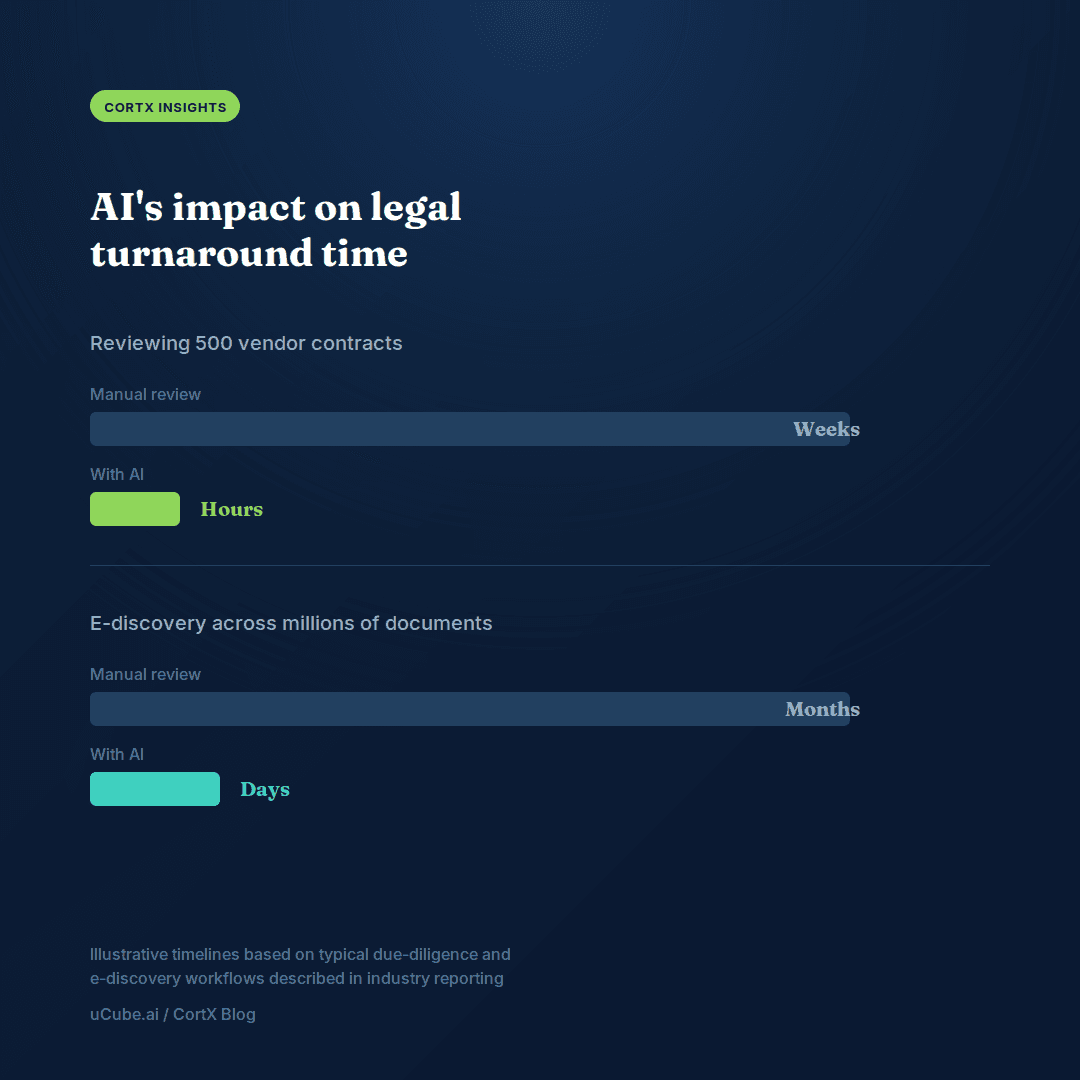
In a real world scenario, a due diligence team reviewing 500 vendor contracts for an acquisition might manually take weeks to identify high risk clauses. AI can complete an initial pass in hours, highlighting the contracts that need human attention. This lets lawyers focus their time where it matters most, rather than reading every page of every document.
3. Document Review and E-Discovery
In litigation, e discovery involves reviewing enormous volumes of emails, financial records, and internal communications to find relevant evidence. AI powered document review does not just search for keywords; it understands context, identifies patterns across documents, and flags anomalies that might indicate hidden liabilities or relevant evidence.
This is particularly valuable in cases involving millions of documents, where manual review by a team of associates could take months and cost hundreds of thousands of dollars in billable hours. AI can compress that timeline significantly while maintaining, and in some cases improving, accuracy, since it does not suffer from reviewer fatigue over long stretches of repetitive work.
4. Contract Drafting and Clause Generation
Rather than starting from a blank page or copying from outdated templates, AI can generate first drafts of standard agreements such as NDAs, employment contracts, and vendor agreements, based on a firm's historical documents and preferred language. During negotiations, AI can also redline incoming drafts from opposing counsel, comparing them against the firm's acceptable risk parameters and suggesting alternative clauses.
This does not replace the lawyer's judgment on deal specific terms, but it removes the repetitive drafting work, letting attorneys focus on negotiation strategy and client specific customization.
5. Case Outcome Prediction and Litigation Strategy
By analyzing large datasets of past rulings, AI can identify patterns in how specific courts or judges have ruled on similar types of cases. This allows litigators to give clients data backed advice on whether to settle or proceed to trial, rather than relying purely on experience and intuition.
For instance, a firm evaluating whether to litigate a commercial dispute might use AI to review the historical settlement and trial outcomes for similar cases in that jurisdiction, informing a more strategic and defensible recommendation to the client.
6. Compliance Monitoring and Regulatory Tracking
Regulatory environments change frequently, and law firms advising on compliance need to track updates across multiple jurisdictions. AI can continuously monitor regulatory changes, flag ones relevant to a client's industry, and even map out which existing contracts or policies may be affected.
This is especially useful for firms serving multinational clients, where compliance requirements shift across different regulatory bodies and staying current manually is nearly impossible at scale.
7. Legal Document Summarization
Long filings, judgments, and case files can run into hundreds of pages. AI can summarize these documents into concise briefs, highlighting key facts, holdings, and arguments, so lawyers can quickly get up to speed on a matter without reading every page.
This is particularly valuable for partners reviewing case status across multiple active matters, or when onboarding new team members onto an ongoing case with an extensive document history.
8. Multilingual Translation and Cross-Border Support
In jurisdictions with multiple official languages or firms handling cross border matters, AI powered translation helps ensure accuracy and speed when working with foreign language contracts, judgments, or regulatory filings. This reduces dependency on manual translation services and speeds up cross jurisdictional collaboration.
Challenges and Risks of Legal AI
Every credible discussion of legal AI needs to address its limitations. Firms adopting AI should be aware of a few key risks.
- Data privacy and confidentiality. This is a major concern, since legal work involves highly sensitive client information that must be protected under strict professional obligations.
- Hallucinated outputs. AI systems can produce inaccurate outputs, particularly when generating case citations, so human verification remains essential.
- Jurisdiction-specific compliance. This adds another layer of complexity, since AI tools must be configured to respect local laws and regulatory expectations.
- Accountability. A lawyer using AI remains professionally responsible for the accuracy and appropriateness of the final work product.
How Law Firms Should Approach AI Adoption
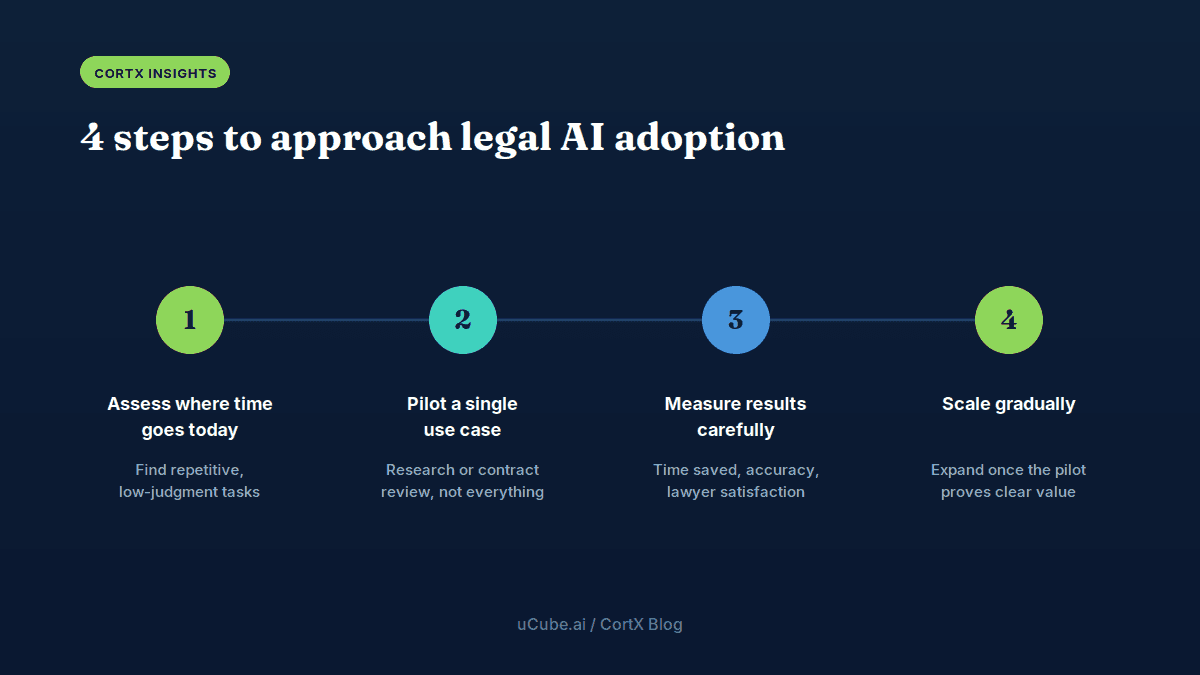
Firms do not need to adopt AI across every function at once. A more effective approach follows four steps.
- Assess existing workflows. Identify where the most time is spent on repetitive, low judgment tasks.
- Pilot on a single use case. Start with one area, such as contract review or legal research, rather than attempting a firm wide rollout immediately.
- Measure results carefully. Track time saved, accuracy, and lawyer satisfaction with the tool.
- Scale gradually. Expand to additional practice areas once the pilot demonstrates clear value and the team is comfortable with the technology.
What Does the Future of AI in Law Look Like?
The legal profession is moving toward a hybrid model where human judgment and machine efficiency work together. Lawyers will remain central to interpretation, negotiation, advocacy, and client relationship management, while AI increasingly handles the first pass of information heavy tasks.
Firms that adopt AI thoughtfully will likely gain an edge in speed, quality, and client responsiveness, not because the technology is flashy, but because the operational model becomes more scalable.
Key Takeaways
- AI is already active in legal research, contract review, and document workflows across India, the UAE, and other major markets.
- India's legal system benefits from AI in translation, case summarization, and research efficiency.
- The UAE's justice sector is integrating AI into consultations and digital service delivery.
- AI complements rather than replaces legal judgment and advocacy.
- Firms that adopt AI early are better positioned for faster, more scalable legal operations.
Frequently Asked Questions
Legal AI is primarily used for legal research, contract review, document summarization, translation, and workflow automation.
AI allows lawyers to search using natural language instead of rigid keywords, surfacing more contextually relevant precedents faster.
Yes. Consulting firm research shows AI adoption in legal research, contract review, and risk workflows is moving from experimentation to standard practice.
India and the UAE are both notable markets, with government backed AI initiatives in courts and justice ministries supporting broader adoption.
Lawyers increasingly need basic technical literacy to evaluate AI outputs, along with strong critical thinking to verify accuracy and apply professional judgment to AI generated work.
Traditional legal tech typically automates fixed, rule-based processes, while generative AI can understand context, generate new text, and adapt to varied queries and documents.
Regulation varies by jurisdiction, but most bar associations and legal regulators emphasize that lawyers remain fully accountable for AI assisted work, requiring human review before anything is filed or sent to a client.

Turn this insight into your next move.
Tell us what you're building and we'll show you where uCube.ai actually fits — no generic demo, just a straight conversation about your data and your goals.