


AI & Data Fundamentals
API vs Connector: What's the Difference? A Complete Guide
What Is an API?
An API, or application programming interface, is a defined contract that lets one piece of software ask another for data or request an action, without needing to know how that other system works internally. It specifies the available endpoints, what parameters a request accepts, what format a response comes back in, and how authentication is handled.
An API is a building block, not a finished integration. It tells you how you're allowed to talk to a system, but someone still has to write the code that calls the right endpoints, handles errors, manages authentication tokens, deals with rate limits, and keeps working when that API changes. A single application might expose dozens of API endpoints; using them to power a real feature is still an engineering project.
What Is a Connector?
A connector is a working integration built on top of one or more APIs. Where an API is the raw interface, a connector is the software that actually uses it, handling authentication, pulling or pushing data on an ongoing basis, transforming that data into a usable shape, and managing the operational details, retries, rate limiting, error handling, so the application using the connector doesn't have to.
Connectors are typically built for a specific purpose: sync contacts from a CRM, pull tickets from a support platform, or feed HR records into an AI assistant. Many are also normalized, meaning a connector for one CRM and a connector for a different CRM expose the same consistent fields and objects, even though the underlying APIs look nothing alike.
Key Differences
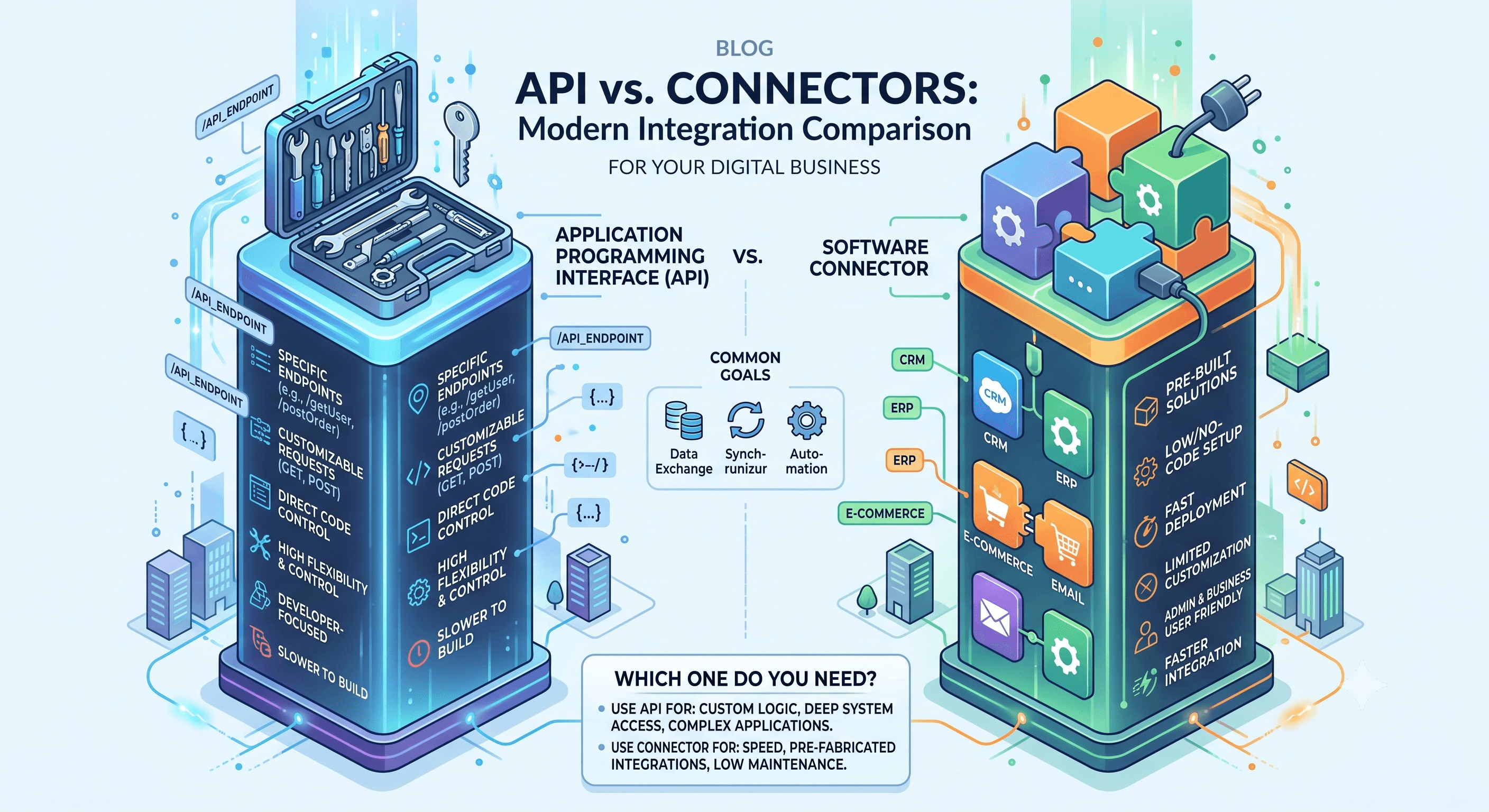
- Scope. An API is an interface specification. A connector is a built integration that uses one or more APIs to move data or trigger actions for a specific purpose.
- Effort to use. Calling an API from scratch means writing and maintaining the integration code yourself. A connector is largely ready to use, since that work has already been done.
- Normalization. Raw APIs return data in whatever format the source system defines. Connectors, especially unified ones, often normalize that data into a consistent schema across many different source systems.
- Maintenance ownership. If you build directly against an API, your team owns fixing things when that API changes. With a connector, especially a vendor-maintained one, that maintenance burden shifts to the connector provider.
- Directionality and state. An API call is typically a single request and response. A connector often manages ongoing state, tracking what's already been synced, handling incremental updates, and keeping two systems consistent over time.
How They Work Together
APIs and connectors aren't competing options so much as different layers of the same stack. Every connector is built using APIs; the connector just adds the integration logic, normalization, and ongoing management on top. When an AI product integrates with a customer's CRM, for example, a connector is what handles calling that CRM's API correctly, keeping data in sync, and presenting it to the AI model in a consistent shape.
This is also why AI connectors have become their own category rather than just being described as APIs. The distinguishing work isn't the request and response itself, it's everything a connector does around that request: normalizing data across many source APIs, handling authentication for many different applications, and managing sync state so an AI system always has current information to work with.
When to Use Each
- Build directly against an API when you need very specific, low-level control over a single application's behavior, or when no existing connector covers what you need and the integration is core enough to justify owning it.
- Use a connector when you want to support an application quickly without owning the ongoing integration work, or when you need the same kind of data, like tickets or contacts, normalized consistently across many different applications in a category.
- Use a unified connector platform when you need to support many applications within a category, like CRM or HRIS, and want a single integration to cover all of them rather than building and maintaining each one separately.
Benefits and Trade-offs
- Direct API integration: gives full control and no dependency on a third party, but means your team absorbs all the engineering time, ongoing maintenance, and risk of the API changing underneath you.
- Purpose-built connector: reduces engineering effort for that specific integration, but ties you to however that connector was designed and however quickly its maintainer keeps it updated.
- Unified connector platform: maximizes the number of applications you can support with one build, at the cost of some flexibility for edge cases specific to a single application.
Best Practices
Match the approach to how core the integration is.
Reserve custom, direct API work for integrations that are central to your product's value; lean on connectors for everything else.
Don't rebuild what already exists.
Before writing custom API integration code, check whether a connector already covers the application and category you need.
Plan for API change regardless of approach.
Whether you build directly or use a connector, third-party APIs evolve. Build monitoring and alerting so you catch breaking changes quickly either way.
Normalize data early if you're building your own connector.
If you do build a custom connector rather than using an existing one, define a consistent internal schema up front so it can support multiple source applications later without rework.
Keep authentication and permissions scoped tightly.
Whether calling an API directly or through a connector, request only the access scopes the integration actually needs.
Frequently Asked Questions
No. An API is the interface a system exposes for other software to use. A connector is a built integration that uses one or more APIs to move data or trigger actions for a specific purpose, adding authentication handling, normalization, and ongoing sync management on top.
Yes, and many teams do for integrations that are central to their product. It just means your team is responsible for writing and maintaining all the integration logic, rather than relying on a connector that's already built and maintained.
They can call APIs directly, but as the number of applications an AI product needs to support grows, connectors, especially unified ones, become far more practical since they normalize data across many APIs and remove the need to build and maintain each integration individually.
Security depends on implementation quality rather than the category itself. A well-built direct integration and a well-built connector can both apply strong authentication, encryption, and access controls; the practical difference is who is responsible for maintaining those protections over time.
Not entirely. Connectors reduce the amount of API-specific code a team has to write and maintain, but understanding how the underlying API behaves is still useful for debugging issues, understanding rate limits, and knowing what a connector can and can't do.
Turn this insight into your next move.
Tell us what you're building and we'll show you where uCube.ai actually fits — no generic demo, just a straight conversation about your data and your goals.