


AI & Data Fundamentals
What Is Computer Vision? A Complete Guide
What Is Computer Vision?
Computer vision is the branch of AI that teaches machines to read images and video. The point is to support real decisions and actions, not just to see. This goes well beyond capturing or cleaning up a picture. The goal is to pull meaning out of it: what is in the scene, where it sits, and what it signals.
It's easy to confuse computer vision with image processing, but the two solve different problems. Image processing manipulates an image, sharpening it, adjusting brightness, removing noise, without any understanding of its content. Computer vision works out what the image shows. It then acts on that, flagging a defect or labeling an object. The two often work together. Image processing cleans up a picture so the vision model can read it reliably.
Why Computer Vision Matters
Cameras and sensors are everywhere: phones, vehicles, factories, public spaces. No human team could review that much footage by hand. Computer vision makes that footage usable. It turns raw pixels into structured data a business can act on in real time. That might mean catching a defect before a product ships, or helping a car spot a pedestrian.
It also matters because visual interpretation, once one of the hardest problems in AI, has advanced dramatically. Object recognition used to be about as accurate as a coin flip. In under a decade, deep learning pushed it past human performance. That leap has opened the door to applications that weren't practical even a few years ago.
How Computer Vision Works
Most computer vision systems follow a similar pipeline, regardless of the specific task:
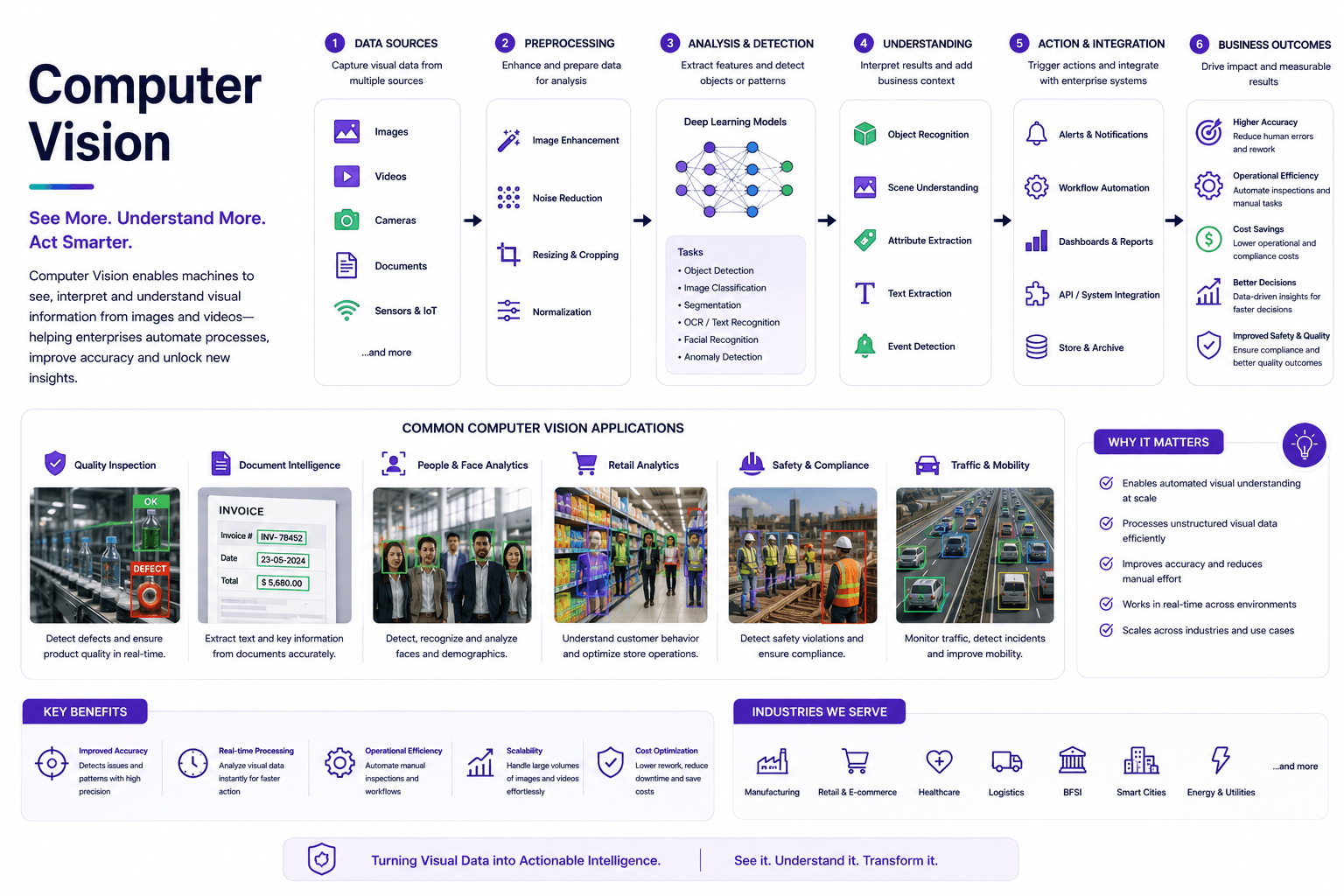
- Image acquisition. A camera or sensor captures a visual scene and converts it into a digital format, represented as a grid of pixel values.
- Preprocessing. Raw images are cleaned up and standardized. Brightness and contrast get adjusted and everything is resized to one shape. Extra variations are sometimes generated so the model copes with new images.
- Feature extraction. The system identifies measurable visual attributes, edges, shapes, textures, colors, that capture the essential information in an image. In deep learning models, this happens automatically as the network learns which patterns matter.
- Model training. A model learns to link those features to the right answer, training on large sets of labeled examples. That model is usually a convolutional neural network, or now often a vision transformer.
- Output generation. The trained model then reads images it has never seen. Depending on the task, the output is a label, a bounding box, or a segmented region.
Core Model Types
Convolutional neural networks, or CNNs, have long been the dominant architecture for computer vision. They read an image in layers. Early layers learn simple patterns such as edges. Later ones build up to shapes and, in the end, whole objects.
Vision transformers are the newer alternative. They apply the attention approach from language models to images, treating patches of a picture the way a language model treats words. They can match or exceed CNN performance on many tasks, especially at large scale, and are increasingly common in state-of-the-art systems. Recurrent neural networks and related architectures are also used when the task involves a sequence of images, such as analyzing video.
Common Computer Vision Tasks
- Image classification — assigning an image to one overall category, such as identifying an X-ray as normal or showing signs of a condition.
- Object detection — finding specific objects in an image and marking where each one sits, usually with a bounding box. This is how traffic footage picks out vehicles and pedestrians.
- Image segmentation — labeling an image pixel by pixel instead of with a box. That traces the exact shape and edge of an object, which is what outlining a tumor on a scan requires.
- Object tracking — following a specific object across a sequence of video frames, maintaining its identity as it moves.
- Facial recognition — a specialized form of recognition that captures and compares key facial features to identify or verify individuals.
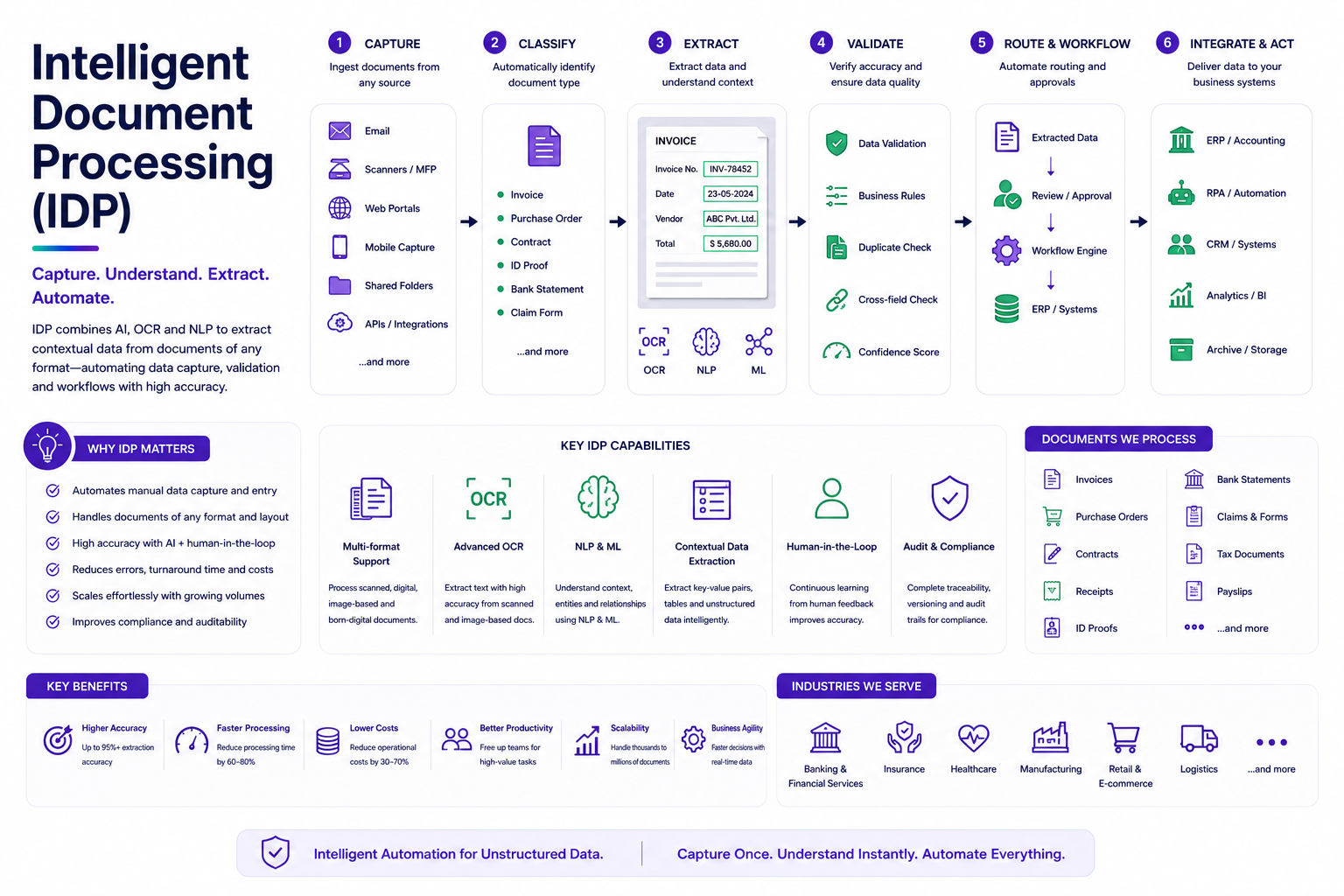
- Optical character recognition — extracting and converting text found in images or scanned documents into machine-readable text.
- Scene and behavior understanding — reading the relationships between objects, not just the objects. It can tell that one vehicle is turning in front of another.
- Image generation — using generative models to create new images, ranging from producing realistic synthetic photos to generating an image from a text description.
Industry Applications
- Healthcare — reading X-rays, CT, and MRI scans alongside a radiologist to help spot and locate markers of disease. It is often faster and more consistent than manual review alone.
- Manufacturing — automating visual quality inspection to catch defects before products ship, and monitoring equipment for early signs of wear or malfunction.
- Autonomous vehicles and robotics — combining object detection, segmentation, and scene understanding to help vehicles and robots navigate safely around obstacles, pedestrians, and other traffic.
- Retail — running automated checkout and inventory tracking. It also drives visual search, so a customer can shop with a photo instead of a text query.
- Agriculture — analyzing drone and satellite imagery to monitor crop health, detect pests, and estimate yields across large areas of land.
- Security and surveillance — monitoring facilities and public spaces for unusual activity and flagging unauthorized access in real time.
Challenges to Plan For
- Data quality and volume. These models need large, varied, well-labeled datasets to work reliably. Gathering and labeling that data is slow and expensive.
- Bias in training data. If a dataset skews toward certain conditions, demographics, or contexts, the resulting model can underperform or behave unfairly outside those conditions.
- Computational cost. Training and running vision models, especially at scale or in real time, can require substantial GPU or specialized hardware resources.
- Privacy and governance. Facial recognition and surveillance raise real privacy and ethical questions. Both now fall under specific rules. Design for those rules up front rather than bolting them on.
- Reliability on edge cases. Models turn unpredictable when the scene looks nothing like their training data. Test hard across varied, realistic conditions before you deploy.
Best Practices for Building Computer Vision Applications
Start with a specific, well-defined problem.
Choose a narrow, practical use case, like detecting one type of defect, rather than attempting broad, general-purpose visual understanding from the outset.
Prioritize data quality over data volume alone.
A small, carefully labeled, varied dataset usually beats a big noisy one. Spend the effort on labeling accuracy and on covering real-world conditions.
Use transfer learning where possible.
Start from a model already trained on a large, general dataset. Fine-tuning it is far faster and cheaper than training from scratch.
Test across realistic, varied conditions.
Validate on edge cases and on conditions the training set never covered. Testing only on familiar-looking data tells you very little.
Build in governance from the start.
Build access controls, bias checks, and compliance into the first design. That matters most for anything touching biometric data or surveillance.
Frequently Asked Questions
Computer vision is an application area within artificial intelligence that commonly relies on machine learning, and especially deep learning, to interpret visual data. So while not every computer vision technique uses machine learning, most modern, high-performing systems do.
Image processing manipulates or enhances an image, such as sharpening or adjusting color, without understanding its content. Computer vision analyzes an image to determine what it depicts and can trigger a decision or action based on that understanding.
It depends heavily on the task's complexity. Simple classification with only a few categories might need a few thousand labeled images, while robust object detection across varied real-world environments can require millions. Transfer learning and data augmentation can sharply reduce how much new labeled data is needed.
Yes, though it depends on model complexity, available hardware, and latency requirements. Techniques like model compression, quantization, and running inference on edge devices close to the data source all help make real-time performance achievable.
Yes. Adoption continues to expand across healthcare, manufacturing, retail, agriculture, and robotics, driven by advances like vision transformers, generative AI, and more accessible tooling that lowers the barrier to building vision applications.
Turn this insight into your next move.
Tell us what you're building and we'll show you where uCube.ai actually fits — no generic demo, just a straight conversation about your data and your goals.