

AI & Data Fundamentals
What Is Generative AI? A Complete Guide
What Is Generative AI?
Generative AI is a class of artificial intelligence that produces new content, text, images, audio, video, or software code, rather than simply classifying, retrieving, or analyzing content that already exists. Give it a prompt, and it generates an original response rather than pulling up a pre-written answer.
That distinction matters more than it sounds. Older machine learning systems were mostly built to make a judgment call on existing data: is this transaction fraudulent, is this email spam, does this photo contain a defect. Generative AI flips the task around. Instead of judging, it creates, drafting a contract clause, sketching a product concept, writing a block of code, or generating a synthetic dataset that never existed before but statistically resembles data that could.
Why Generative AI Matters
The reason generative AI moved from research labs to boardrooms so quickly comes down to how broadly it applies. Nearly every knowledge-work task, drafting, summarizing, coding, designing, forecasting, involves producing some form of content, and generative AI can now assist with a meaningful share of that work directly.
It also matters because of pace of adoption. Since large language model chatbots entered public use, organizations across every sector have been racing to figure out where the technology fits into their own workflows, not because it's novel, but because the productivity gap between teams using it well and teams ignoring it is becoming difficult to ignore. Analysts tracking enterprise AI adoption expect the large majority of organizations to have some form of generative AI in production within the next couple of years, which puts pressure on the slower movers to catch up rather than wait and see.
How Generative AI Works
Generative AI systems are typically built and deployed in three stages:
- Training a foundation model. A deep learning model is trained on enormous volumes of unlabeled data, text scraped from the web, images, code repositories, and taught to predict the next piece of a sequence: the next word, the next pixel region, the next line of code. Over billions of these prediction exercises, the model builds an internal representation of patterns, structure, and relationships in the data. This stage is extremely resource-intensive, requiring large GPU clusters and weeks of compute, which is why most organizations build on top of an existing foundation model rather than training one from scratch.
- Tuning the model for a specific task. A foundation model is a generalist. To make it useful for a specific application, a customer support assistant, a procurement analysis tool, a code reviewer, it needs to be tuned. This can involve fine-tuning on labeled examples specific to the task, or reinforcement learning from human feedback, where people score or correct the model's outputs so it learns what a good response looks like for that use case.
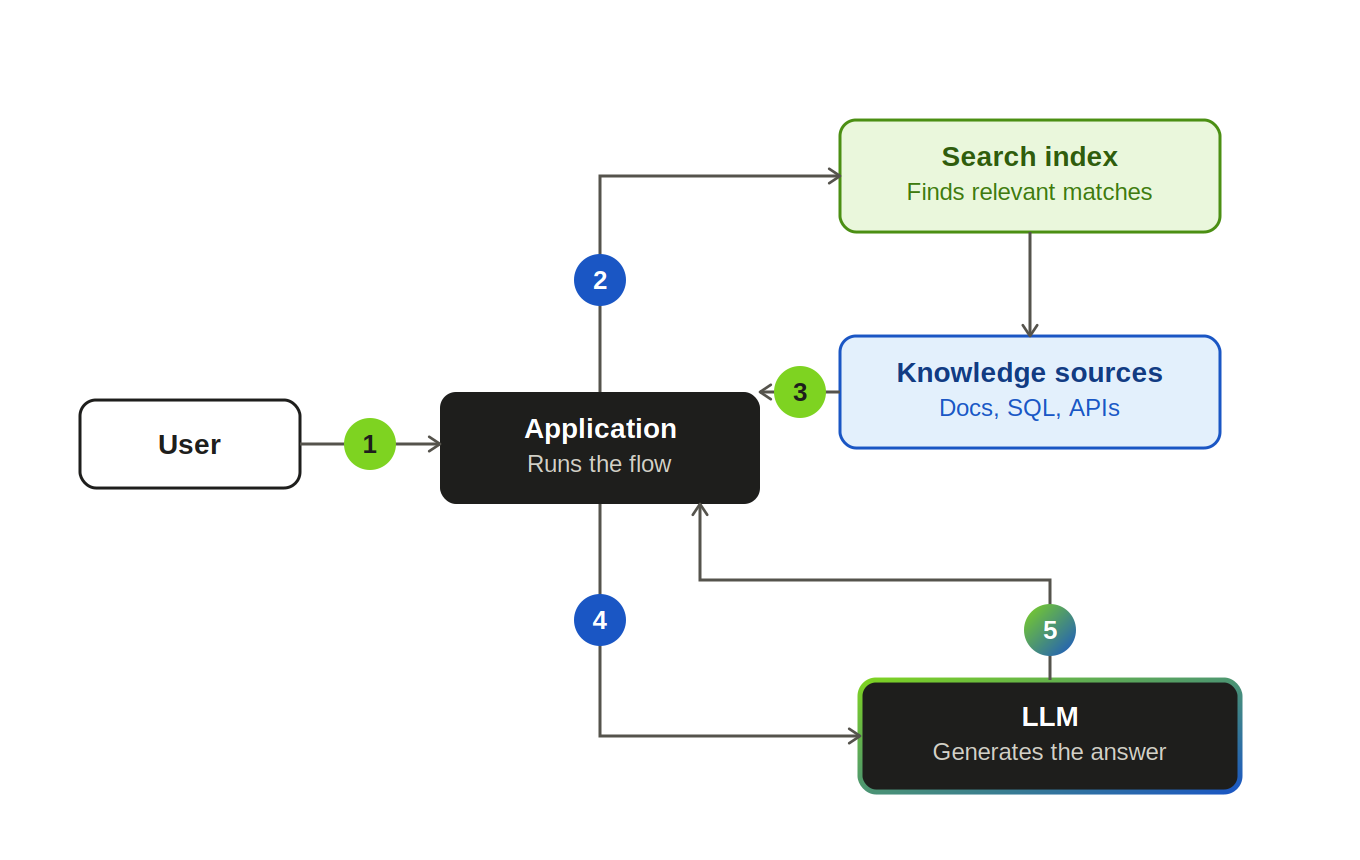
- Generating, evaluating, and retuning. Once deployed, outputs are continually reviewed and the model is adjusted for accuracy and relevance, often on a much faster cycle than the foundation model itself gets updated. Many production systems also pair the model with retrieval-augmented generation (RAG), which lets it pull in current, organization-specific information at the moment of the query instead of relying solely on what it learned during training.
Model Architectures Behind Generative AI
Several distinct architectures make generative AI possible, each suited to different kinds of output.
- Variational autoencoders (VAEs) compress data down into a simplified internal representation and then reconstruct variations of it. They're fast and useful for anomaly detection and straightforward image generation, though they tend to produce less detailed output than newer architectures.
- Generative adversarial networks (GANs) pit two networks against each other, a generator that creates content and a discriminator that judges whether it looks authentic. The back-and-forth pushes output quality up quickly, though GANs can be tricky to train without one network overwhelming the other.
- Diffusion models work by gradually corrupting training data with noise, then learning to reverse that process. Once trained, they can generate high-quality content, images especially, out of pure noise, and they now power many of the leading image-generation tools on the market.
- Transformers introduced the idea of attention: the ability to weigh which parts of an input sequence matter most to understanding the rest of it. This made it possible to train on massive text datasets and generate long, coherent, context-aware output, and it's the architecture behind essentially every major large language model in use today.
What Generative AI Can Create
- Text. Emails, reports, product copy, documentation, summaries, and code comments, at a fraction of the time it takes a person to draft the first version.
- Images and video. Original artwork, product mockups, style transfers, and increasingly, short video clips generated from a written description.
- Audio and music. Natural-sounding speech for voice assistants, narration, and original music composition in a specified style or genre.
- Software code. Autocompleted functions, translated code between languages, and plain-language explanations of what an unfamiliar codebase actually does.
- Synthetic data. Artificial datasets that preserve the statistical patterns of real data without containing any actual sensitive records, useful for testing, training, and privacy-conscious analytics.
Generative AI vs. AI Agents
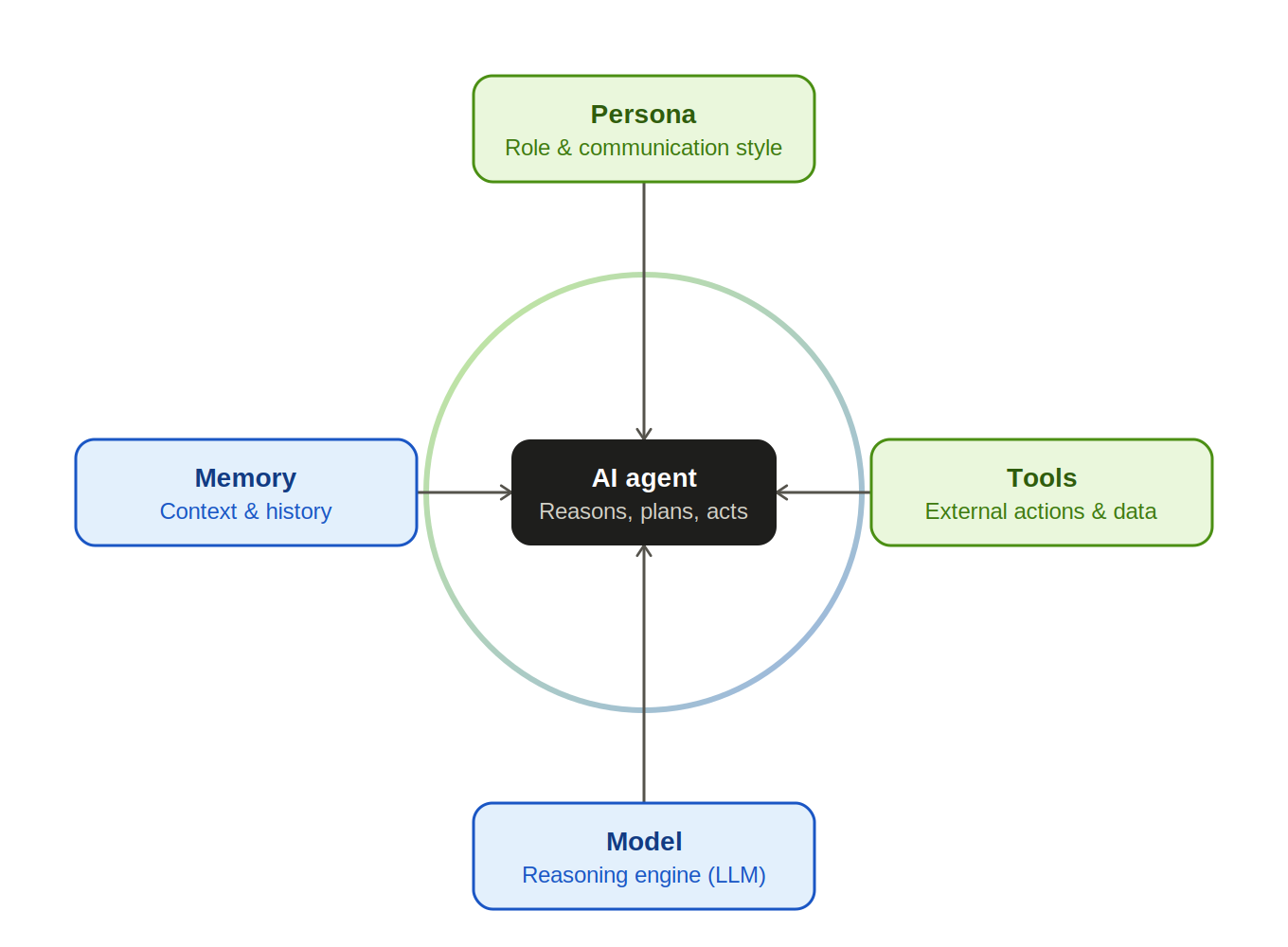
Generative AI and AI agents are often mentioned in the same breath, but they solve different problems. Generative AI produces content in response to a prompt, a paragraph, an image, a snippet of code. An AI agent goes a step further: it can take that output, decide on a sequence of actions, and actually carry them out using other tools and systems, with limited or no human intervention at each step.
Put simply, generative AI can tell you the best way to phrase a vendor negotiation email. An agent can draft it, check it against your procurement policy, and send it. Agentic systems, where multiple agents coordinate on a larger task, are increasingly built on top of generative AI models rather than replacing them, which is part of why the two terms get used interchangeably even though they describe different layers of the same stack.
Industry Applications
- Retail. Smarter customer service chatbots, personalized product recommendations, and demand forecasting that adapts to real-time signals.
- Financial services. Risk analysis, fraud detection, and large-scale report generation, including purpose-built models trained specifically on financial data and terminology.
- Manufacturing and procurement. Automated reporting on operations, predictive maintenance recommendations, and AI-assisted analysis of supplier quotes, contracts, and commercial terms.
- Healthcare and life sciences. Faster candidate identification in drug discovery, synthetic medical imaging for training diagnostic models, and automated clinical documentation.
- Legal and professional services. Drafting and reviewing contracts, summarizing case law, and flagging unusual clauses across large volumes of documents.
Benefits of Generative AI
- Faster content and knowledge work. Drafts, summaries, and first-pass analysis that used to take hours can be produced in minutes, freeing people to focus on judgment calls rather than first drafts.
- Better decisions, faster. By synthesizing large volumes of data into a direct answer instead of a list of documents to sort through, generative AI shortens the time between a question and an informed decision.
- Personalization at scale. Content, recommendations, and responses can be tailored to an individual's history and context in real time, rather than relying on broad segments.
- Round-the-clock availability. Unlike a human team, generative AI systems don't need shifts, making always-on customer support and monitoring genuinely practical.
Challenges and Risks
- Hallucinations. Generative models can produce confident, fluent, and entirely incorrect output. This is especially risky in domains like legal research, medical guidance, or financial reporting, where a plausible-sounding but wrong answer can cause real harm. Grounding models in verified data sources, through RAG or similar techniques, is one of the most effective mitigations.
- Bias. Models trained on real-world data can absorb and repeat the biases present in that data. Careful data curation, evaluation, and ongoing monitoring are necessary to catch and correct this over time.
- Inconsistency. The same prompt can produce different outputs on different runs, which is a problem for use cases that need predictable, repeatable results. Prompt engineering and tighter tuning can reduce this, though rarely eliminate it entirely.
- Explainability. Many generative models are effectively black boxes, making it hard to trace exactly why a given output was produced. This complicates governance, especially in regulated industries.
- Security, privacy, and IP exposure. Sensitive information entered into a prompt or used for tuning can end up reflected in outputs, and organizations need clear policies on what data is safe to use with which tools.
Best Practices for Adopting Generative AI
Start with a well-defined use case, not the technology itself.
Pick a specific, high-value workflow, say, summarizing vendor quotes or drafting first-pass support responses, rather than deploying generative AI broadly and hoping value emerges.
Ground outputs in your own data wherever accuracy matters.
Pairing a model with retrieval-augmented generation over verified internal sources meaningfully cuts down on hallucinations compared to relying on the base model alone.
Build in human review for high-stakes outputs.
Anything customer-facing, legally binding, or financially significant should have a review step until the system's reliability is well established for that specific task.
Evaluate continuously, not just at launch.
Track output quality, user corrections, and edge cases on an ongoing basis, and treat model tuning as a recurring process rather than a one-time setup.
Set clear data governance policies before scaling.
Decide upfront what data can be used for prompts and tuning, and make sure those decisions account for both your own IP and any third-party data you handle.
Frequently Asked Questions
Traditional AI models are typically built to classify, predict, or score existing data, deciding whether something is true, likely, or anomalous. Generative AI is built to produce new content that didn't exist before, drawing on patterns learned during training.
ChatGPT is one product built on generative AI, specifically a large language model tuned for conversational text. Generative AI is the broader category that also includes image generators, code assistants, music composition tools, and more.
Not necessarily. Most organizations use a pre-trained foundation model rather than training one from scratch, and then fine-tune or ground it with a comparatively small amount of task-specific or organizational data.
Generative AI produces content in response to a prompt. An AI agent uses that content, along with other tools and systems, to actually carry out multi-step tasks with limited human involvement. Agents are often built on top of generative AI models rather than being a separate technology.
Hallucinations, confident but incorrect outputs, tend to be the most consequential risk, particularly in domains like legal, financial, or medical work. Grounding the model in verified data and keeping a human in the loop for high-stakes decisions are the most reliable mitigations available today.
Turn this insight into your next move.
Tell us what you're building and we'll show you where uCube.ai actually fits — no generic demo, just a straight conversation about your data and your goals.