


AI & Data Fundamentals
What Are Large Language Models (LLMs)? A Complete Guide
What Is a Large Language Model?
A large language model, or LLM, is a type of generative AI built to understand and produce human language at scale. LLMs are trained on enormous collections of text using advanced machine learning techniques, letting them learn the underlying patterns and structure of language well enough to generate coherent responses to written prompts.
They represent a major leap over earlier language models. A single LLM can handle a wide range of tasks, answering questions, summarizing documents, translating languages, writing original content, and holding open-ended conversations, all without being built for just one narrow purpose. Well-known examples include the GPT family of models, Claude, Gemini, Llama, and BERT.
LLMs are big almost by definition. Many contain hundreds of billions of parameters, and some accept extremely long inputs, letting them work across hundreds of pages of text or an entire book in a single prompt. That scale is a big part of what lets them generalize across so many different language tasks, though it also means they require thoughtful, responsible use rather than blind trust in their output.
Core Capabilities
- Natural language understanding — grasping context, semantics, and intent behind human language, not just matching keywords.
- Multimodal content generation — producing text for tasks ranging from code to creative writing, and increasingly images, speech, and other formats too.
- Question answering — responding intelligently to open-ended questions rather than only pre-programmed queries.
- Scalability — using GPU acceleration to handle large-scale language tasks and grow with increasing demand.
How Do LLMs Work?
Most modern LLMs are built on a transformer architecture. Older models, like recurrent neural networks, processed text sequentially, one word at a time. Transformers instead process an entire sequence at once, which is both faster and better at capturing the relationships between distant words in a sentence.
Here's the basic pipeline:
- Tokenization. Input text gets broken into tokens, which might be a full word, part of a word, or even a single character.
- Embedding. Each token is converted into a numerical vector, called a word embedding, positioned in a multi-dimensional space so that words with related meanings end up close to one another.
- Self-attention. For each token, the model asks how much every other token in the sequence matters to its meaning. This is what lets a model correctly figure out, for instance, which noun a pronoun like "it" is actually referring to in a given sentence.
- Prediction. Using everything it's learned, the model predicts the most likely next token, and repeats this process to generate longer, coherent output.

A full transformer typically has two halves: an encoder, which converts input into an intermediate representation, and a decoder, which turns that representation into final output text. Encoders tend to use bidirectional self-attention (looking at context from both directions), while decoders use unidirectional attention, since they generate output one token at a time and can only look at what's already been produced.
Each self-attention layer is usually made up of multiple attention "heads," each capable of learning a different kind of relationship between words, one might track grammatical structure while another tracks sentiment or thematic connections. Stacking many of these layers on top of each other lets the model build progressively more abstract, nuanced understanding as information moves deeper through the network.
At the end of the day, an LLM is essentially predicting the most likely continuation of a given input, extended out to full sentences, paragraphs, or entire responses, rather than just the next single word the way older autocomplete tools did.
Why Are LLMs So Large?
Transformers can contain hundreds of billions, even trillions, of parameters (the weights and biases learned during training). While smaller models are generally more resource-efficient, research consistently shows that larger transformer models tend to outperform smaller ones on most tasks, which is a big part of why the field has trended toward ever-larger architectures.
Pretraining vs. Fine-Tuning
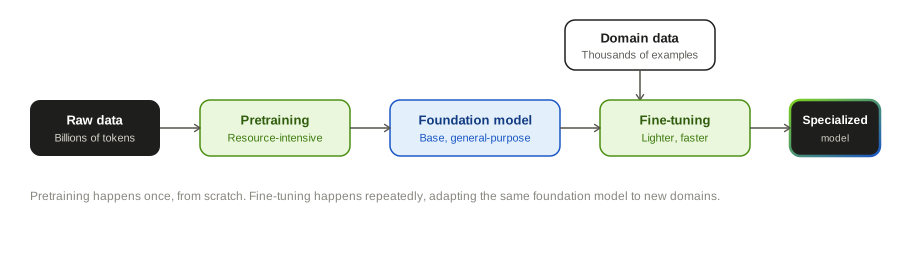
Pretraining means training a model from scratch on a massive body of text or code, without relying on any existing model's weights. The result is a base model that can either be used directly or adapted further. Pretraining tailors a model's foundational knowledge to a specific domain and produces something genuinely differentiated by an organization's own data, but it's also the most expensive and resource-intensive form of training, and it's out of reach for most organizations to do routinely.
Fine-tuning adapts an already-pretrained model using a much smaller, domain-specific dataset. The model continues training for a relatively short time, often adjusting only a fraction of its total weights. Two common approaches:
- Supervised instruction fine-tuning — continued training on a set of labeled input-output examples, often numbering in the thousands.
- Continued pretraining — using unstructured, domain-specific text to continue the same underlying training process (like next-token prediction) without paired examples.
Fine-tuning lets an organization take a general-purpose foundation model and shape it around its own data for better accuracy and domain fit, while also giving it more control over exactly what data goes into that training process.
Customizing an LLM With Your Own Data
There are four general architectural approaches to adapting an LLM to an organization's data, and they're not mutually exclusive; most real deployments combine several:
| Method | What it does | Best for | Data needed |
|---|---|---|---|
| Prompt engineering | Crafts specialized prompts to guide model behavior | Quick, on-the-fly guidance | None |
| Retrieval-augmented generation (RAG) | Combines the model with external knowledge retrieval | Dynamic, frequently changing data | An external knowledge base or vector database |
| Fine-tuning | Adapts a pretrained model to a specific domain or task | Domain or task specialization | Thousands of labeled examples |
| Pretraining | Trains a model entirely from scratch | Highly unique tasks or domains | Billions to trillions of tokens |
Prompt Engineering
Prompt engineering is the practice of adjusting the wording given to a model to get more accurate or relevant output. Since it's model-specific, techniques that work well for one model may need adjusting for another, but a few general tips tend to help broadly:
- Use clear, concise prompts that include instructions, relevant context, and a description of the output format you want.
- Provide a few examples in the prompt itself (often called "few-shot learning") to show the model what a good answer looks like.
- Tell the model how to behave, including explicitly allowing it to admit when it doesn't know something.
- Ask the model to reason step by step or explain its thinking.
- If user input is part of the prompt, clearly separate your instructions from that input to reduce the risk of prompt injection.
Retrieval-Augmented Generation
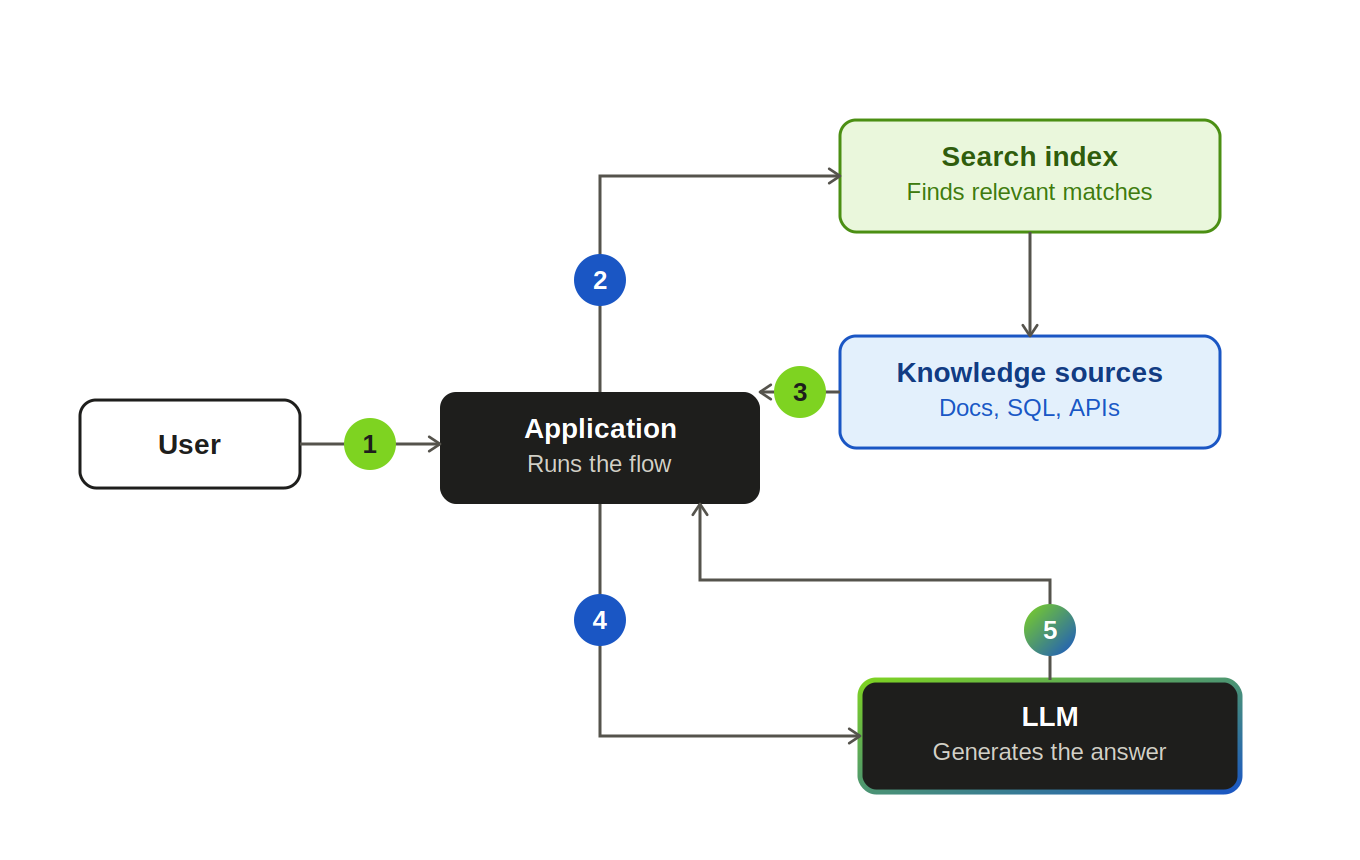
RAG improves an LLM's output by retrieving documents or data relevant to a given question and feeding that content in as context before the model generates a response. It's proven especially useful in support chatbots and Q&A systems that need to stay current or draw on specialized, domain-specific knowledge rather than relying purely on what the model learned during training.
Common Use Cases for LLMs
- Chatbots and virtual assistants — powering open-ended conversations for customer support, lead follow-up, and general assistant tasks.
- Content creation — generating articles, blog posts, and social media copy.
- Code generation and debugging — writing code snippets, spotting bugs, and completing programs from natural language instructions.
- Sentiment analysis — gauging the tone behind a piece of text, useful for measuring customer satisfaction.
- Text classification and clustering — organizing and categorizing large volumes of text to surface themes and trends.
- Language translation — translating documents and web content to reach new markets.
- Summarization and paraphrasing — condensing long documents, calls, or meetings into their key points.
- Security — helping spot threat patterns and automate parts of an incident response.
Proprietary vs. Open-Source Models
LLMs generally fall into two broad camps.
Proprietary models are developed and owned by private companies and typically require a license or API access. High-profile examples include the GPT family of models (which power ChatGPT), Google's Gemini, and Anthropic's Claude.
Open-source models can be self-hosted, and the open-source community has closed much of the performance gap with proprietary options in recent years. Popular examples include Meta's Llama models and Mixtral.
Choosing between the two usually comes down to a few key trade-offs:
- Future-proofing. A proprietary model can be deprecated or changed by its provider, which can break existing pipelines; an open-source model, once downloaded, stays accessible indefinitely.
- Cost and performance trade-offs. Open-source and fine-tuned models often allow more tailoring to a specific application and workload.
- Data as an advantage. Planning for future fine-tuning lets an organization use its own data as a genuine competitive edge, something that's harder to do with a closed, proprietary model.
- Governance. Proprietary "black box" models offer less visibility into training data and internal weights, which can raise governance concerns for some organizations. Self-hosting takes more engineering effort but gives full control over the model's behavior and data handling.
Why Did LLMs Suddenly Become So Popular?
A handful of developments converged to bring LLMs into the mainstream:
- Better machine learning techniques, most notably the transformer architecture itself, which underlies nearly every modern LLM.
- Increased accessibility, as consumer-facing chat interfaces gave anyone with an internet connection a simple way to interact directly with a state-of-the-art model.
- More computational power, particularly GPUs, which made training much larger models practical.
- Bigger, better training data. Massive, high-quality datasets, crawled web text, encyclopedic sources, and more, have dramatically improved what these models are capable of.
Benefits and Limitations of LLMs
Benefits. LLMs can produce clear, readable text across a huge range of audiences and tasks, and they perform especially well on tasks close to what they were explicitly trained on.
Limitations
- Hallucinations. LLMs can generate plausible-sounding but factually incorrect output, since they're fundamentally predicting likely text rather than verifying facts.
- Resource intensity. Training requires enormous computational power and electricity, and even running a trained model (inference) at scale consumes significant resources, though larger training runs can sometimes reduce the resources needed per inference.
- Bias. Like any model trained on real-world data, LLMs can reflect and sometimes amplify biases present in their training data.
- Training complexity. Assembling a large enough training set, managing the parallelism needed to train efficiently, and sustaining training over weeks or months all add real engineering complexity.
Evaluating LLM Performance
Evaluating LLMs is genuinely difficult, since a model's performance can vary significantly across tasks, and even small changes in a prompt can shift results meaningfully. A few approaches and frameworks have emerged to bring some structure to this:
- Aggregated evaluation approaches that assess a model across several broad competency domains rather than relying on one single score.
- Community model hubs that gather large numbers of open models for comparison and experimentation.
- BIG-bench, a large, continually expanding benchmark suite designed to test a wide range of language capabilities.
- Holistic evaluation harnesses that combine multiple established benchmarks to support reproducible, comparable results across models.
LLMOps: Operationalizing LLMs in Production
Large language model operations, or LLMOps, cover the practices and tools used to deploy, monitor, and maintain LLMs once they're running in production. Much like traditional MLOps, this typically requires close collaboration between data scientists, DevOps engineers, and IT teams to keep models reliable, monitored, and properly governed over time.
Frequently Asked Questions
Pretraining trains a model from scratch on a massive, general dataset, producing a base model. Fine-tuning takes that already-trained model and adapts it further using a smaller, domain-specific dataset, which is far less resource-intensive.
Self-attention is the mechanism that lets a model weigh how relevant every other token in a sequence is to the one currently being processed, which is what allows it to resolve ambiguous references and understand context across a sentence.
It depends on your priorities. Proprietary models are often easier to get started with but can change or be deprecated by their provider. Open-source models require more setup but offer long-term stability, more customization, and greater control over data and governance.
LLMs generate text by predicting the most statistically likely continuation of an input, not by verifying facts against a ground truth. That means they can produce fluent, confident-sounding statements that are still factually wrong.
Turn this insight into your next move.
Tell us what you're building and we'll show you where uCube.ai actually fits — no generic demo, just a straight conversation about your data and your goals.