


AI & Data Fundamentals
What Is the Model Context Protocol (MCP)? A Complete Guide
What Is the Model Context Protocol?
Large language models are powerful, but they come with two core limitations: their knowledge is frozen at whatever point their training data ended, and they have no built-in way to interact with the outside world. That means an LLM on its own can't pull real-time data or carry out an action like scheduling a meeting or updating a customer record.
The Model Context Protocol, or MCP, was introduced by Anthropic in November 2024 to close that gap. It's an open standard that gives LLMs a secure, consistent way to communicate with external data sources, applications, and services. In effect, it acts as a bridge that turns a model with static knowledge into a dynamic system capable of retrieving current information and actually doing things, making it more accurate, more useful, and far more automated.
MCP builds on ideas like tool use and function calling that already existed, but it standardizes them into a common protocol. That removes the need to build a custom connection for every new pairing of AI model and external system, letting an LLM tap into real-world data, take action, and access specialized capabilities well beyond what it learned during training.
MCP Architecture and Components
MCP is built from a small set of components that work together to let models and external systems talk to each other cleanly.
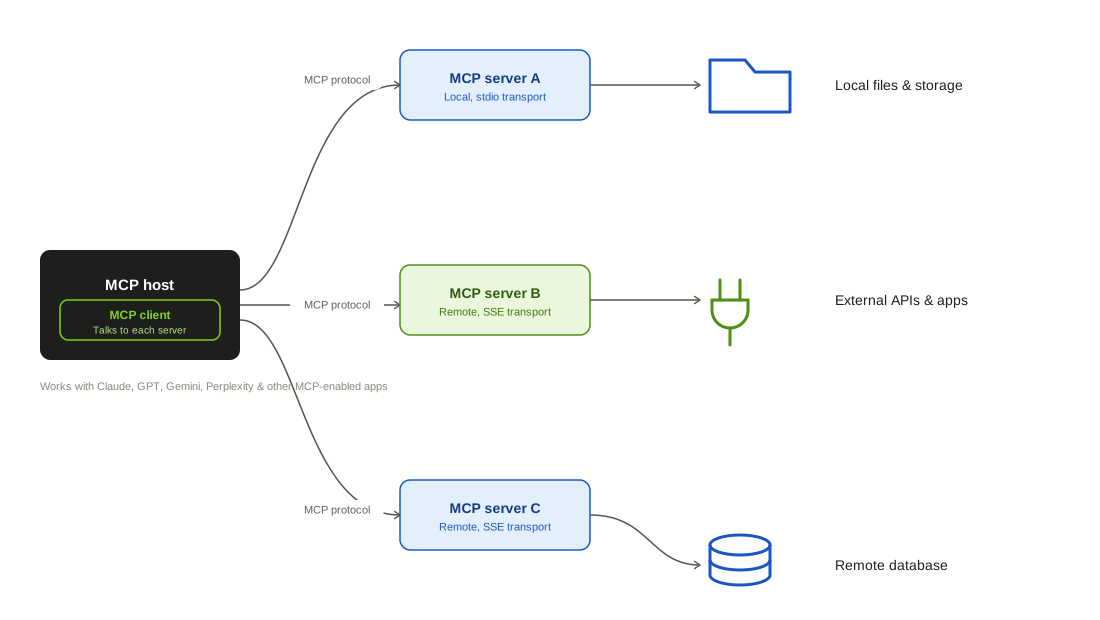
- MCP host. This is the AI application or environment the LLM lives inside, an AI-powered IDE or a conversational assistant, for example. It's typically where the user interacts, and it's responsible for using the LLM to handle requests that may need outside data or tools.
- MCP client. Sitting inside the host, the client acts as a translator between the LLM and any MCP servers, converting the model's requests into the right format and translating server responses back for the model. It's also responsible for discovering which MCP servers are available.
- MCP server. This is the external service that actually supplies context, data, or capability to the model, connecting to things like databases or web services and translating their responses into something the LLM can work with.
- Transport layer. Communication between client and server happens over JSON-RPC 2.0 messages, typically through one of two methods: standard input/output (stdio), which works well for fast, local connections, or server-sent events (SSE), which is better suited for real-time streaming with remote resources.
How Does MCP Actually Work?
Here's a simplified walkthrough using a real request: "Find the latest sales report in our database and email it to my manager."
- Request and tool discovery. The model recognizes it can't query a database or send an email on its own, so it uses the MCP client to look for available tools and finds two registered on MCP servers: one for querying a database, one for sending email.
- Tool invocation. The model builds a structured request to call the database tool first, specifying which report it needs. The client passes that request along to the right server.
- External action and data return. The server translates the request into a secure query against the company's database, retrieves the report, formats it, and sends it back to the model.
- Second action and response generation. With the report data in hand, the model calls the email tool, passing along the manager's address and the report content. Once the email goes out, the server confirms it.
- Final confirmation. The model reports back: "I have found the latest sales report and emailed it to your manager."
MCP vs. RAG
MCP and retrieval-augmented generation (RAG) both extend an LLM with outside information, but they solve different problems. RAG is focused on finding and using information to generate better text; MCP is a broader system for interaction and action.
| MCP | RAG | |
|---|---|---|
| Primary goal | Standardize two-way communication so LLMs can access external tools, data, and services, and perform actions alongside retrieval | Improve responses by pulling relevant information from a knowledge base before generating text |
| Mechanism | A protocol for invoking external functions or requesting structured data from specialized servers | An information-retrieval step that pulls content from a data source to augment the prompt |
| Output type | Structured tool calls, results, and human-readable text based on real actions and data | Text generated from training data plus retrieved, relevant context |
| Interaction style | Active: executes tasks in external systems | Passive: informs generation without executing actions |
| Standardization | An open, cross-vendor standard for tool interaction | A technique or framework, not a universal interaction protocol |
| Typical use cases | Agents booking flights, updating a CRM, running code, fetching real-time data | Q&A systems, chatbots citing current facts, document summarization, hallucination reduction |
Benefits of Using MCP
- Reduced hallucinations. Because LLMs predict answers based on training data rather than live information, they can occasionally produce plausible-sounding but incorrect claims. MCP helps by giving models a reliable path to real, external data sources, which makes responses more grounded and truthful.
- More utility and automation. Without MCP, a model only knows what it was trained on, and that knowledge ages quickly. With it, a model can connect to a wide range of existing tools and integrations, business software, content systems, development environments, letting it handle real-world tasks like updating a CRM record, checking current events, or running a specific calculation. That shift turns an LLM from a pure chat interface into something closer to an agent that can act on its own, opening the door to a lot more automation.
- Simpler connections. Before MCP, wiring an LLM up to different data sources and tools usually meant building custom, vendor-specific integrations, a tangle often referred to as the "N x M" problem, since the number of required connections multiplies fast as new models and tools get added. MCP offers a common, open standard instead, functioning a bit like a USB-C port for AI: one consistent interface instead of a different plug for everything. That lowers development costs, speeds up building AI applications, and makes it easier to switch model providers or add new tools without a major rebuild.
MCP and Security
Connecting an LLM to outside systems through MCP introduces real security considerations, since the model can potentially access sensitive data or trigger code execution through connected tools. A few core principles matter most:
- User consent and control. People need clear visibility into, and control over, what data an LLM accesses and what actions it takes through MCP, ideally through straightforward authorization prompts.
- Data privacy. Hosts should get explicit permission before exposing user data to an MCP server, and sensitive data needs proper access controls, encryption, and safeguards against accidental leaks.
- Tool safety. Since tools can execute code, developers shouldn't blindly trust a tool's description unless it comes from a verified server, and users should understand what a tool does and grant permission before it runs.
- Secure output handling. Responses generated through MCP need careful handling to avoid issues like cross-site scripting if that output gets shown to users, along with proper input sanitization and output filtering.
- Supply chain security. The reliability of MCP servers and the external tools behind them matters a great deal; every link in that chain needs to be secure to avoid biased results, breaches, or failures.
- Monitoring and auditing. Regularly reviewing how an LLM interacts with MCP servers, backed by strong logging, makes it possible to catch unusual activity early and respond quickly if something goes wrong.
Choosing the Right MCP Server Setup
MCP's flexibility means servers can be deployed in a few different configurations, and the right choice depends on performance needs, security requirements, and how much operational complexity a team wants to take on.
Remote vs. Local Servers
- Local servers are best when speed and low latency matter most, for example, providing context from a local IDE or private file system. They typically use fast transport methods like stdio and keep sensitive data from ever crossing a network, making them a strong fit for offline use or confidential data.
- Remote servers offer more flexibility and scale, letting models connect to public APIs or shared enterprise services. Using transport methods like SSE, they support real-time streaming and can serve multiple applications at once, which makes them well suited to shared, reusable tools.
Managed vs. Self-Hosted Servers
- Managed servers, built on serverless platforms or container orchestration services, abstract away infrastructure concerns like auto-scaling and uptime, letting developers focus on the tool's functionality instead of maintaining servers. This is generally the more practical route for enterprise-scale applications.
- Self-hosted servers give an organization maximum control over the deployment environment, running on its own hardware or a custom virtual machine. This fits organizations with strict security, compliance, or legacy-integration requirements that a managed setup can't easily accommodate.
The Role of Open Source in MCP
Because MCP is an open standard, it's spawned a broad ecosystem of open-source implementations across multiple programming languages, which can meaningfully speed up development. Building on open-source MCP components also supports interoperability between different models and services, helps avoid vendor lock-in, and lets an organization benefit from ongoing community-driven improvements.
Frequently Asked Questions
RAG retrieves relevant information to improve what an LLM generates, while MCP is a broader protocol for letting an LLM discover and call external tools to both retrieve information and take real actions, like updating a record or sending an email.
Anthropic introduced MCP in November 2024 as an open standard for connecting LLMs to external data sources and tools.
Yes. By giving a model a standardized way to discover and invoke external tools, MCP turns it from a text-generation system into something that can retrieve live data and execute multi-step actions in the real world.
Because MCP can expose an LLM to sensitive data and let it trigger tool execution, the main risks involve unauthorized data access, unsafe tool behavior, and insecure handling of model output. Following principles like user consent, access controls, and active monitoring helps mitigate these.
Turn this insight into your next move.
Tell us what you're building and we'll show you where uCube.ai actually fits — no generic demo, just a straight conversation about your data and your goals.