

AI & Data Fundamentals
What Is Retrieval-Augmented Generation (RAG)? A Complete Guide
What Is Retrieval-Augmented Generation?
Retrieval-Augmented Generation, or RAG, is a technique for improving how a large language model (LLM) responds by giving it access to trusted, external information at the moment it generates an answer, rather than relying only on what it learned during training.
Traditional LLMs are trained on massive datasets and tuned across billions of parameters so they can perform tasks like answering questions, translating text, and drafting content. But that training data is frozen in time. RAG closes that gap. It lets an LLM pull in company-specific knowledge or specialized domain content on demand, so answers stay accurate and current, all without the time and expense of retraining the underlying model.
Why Does Retrieval-Augmented Generation Matter?
LLMs are the engine behind most modern chatbots and natural language tools. The promise of these tools is simple: give users accurate answers by drawing on credible sources. The problem is that LLMs, left on their own, come with some real limitations.
Common issues include:
- Fabricated answers. When the model doesn't actually know something, it may still generate a confident-sounding but false response.
- Stale or vague answers. Users asking specific, time-sensitive questions may get generic or outdated information instead.
- Unverified sourcing. Responses may be built from content that isn't authoritative or reliable.
- Mixed-up terminology. The same word can mean different things across different data sources, which can lead the model to blend concepts incorrectly.
A useful way to picture an ungrounded LLM is like a new hire who's brilliant and eager, but hasn't kept up with recent developments, and answers every question with total confidence regardless of whether they're right. That combination erodes user trust fast in a customer-facing chatbot.
RAG directly addresses this. Instead of letting the model guess, it points the LLM toward vetted, pre-approved knowledge sources before it responds. That gives organizations more control over what gets generated, and gives users a clearer window into where an answer actually came from.
Key Benefits of Retrieval-Augmented Generation
1. Lower Cost to Implement
Most AI chatbots start from a foundation model, a general-purpose LLM trained on broad, unlabeled data and made available via API. Fully retraining a foundation model to reflect your organization's specific knowledge is expensive and slow. RAG sidesteps that entirely, making it a far more practical and budget-friendly path to bringing generative AI into your business.
2. Access to Current Information
Even a well-trained model becomes outdated the moment new information emerges. RAG lets teams feed the model fresh inputs, whether that's the latest statistics, research, or breaking news, by connecting it directly to live sources like news feeds or social platforms. The result: users get answers that reflect what's true right now, not just what was true when the model was trained.
3. Greater User Trust
Because RAG-powered systems can cite where an answer came from, users can trace a response back to its source and dig deeper if they want. That transparency builds confidence in the system's output in a way that an unsourced answer never can.
4. More Control for Developers
RAG gives development teams a tighter grip on the entire pipeline. They can swap in new data sources as business needs shift, set permission levels so sensitive information is only retrieved by authorized users, and troubleshoot cases where the model pulls from the wrong source. That level of control makes it realistic to deploy generative AI across a much wider range of use cases with confidence.
How Does Retrieval-Augmented Generation Work?
Without RAG, an LLM answers purely from what it learned during training. RAG changes that by inserting a retrieval step before generation: the system first searches an external knowledge source based on the user's query, then hands both the original question and the retrieved content to the LLM. The model uses both to produce a more grounded, informed answer.
Here's the process broken down:
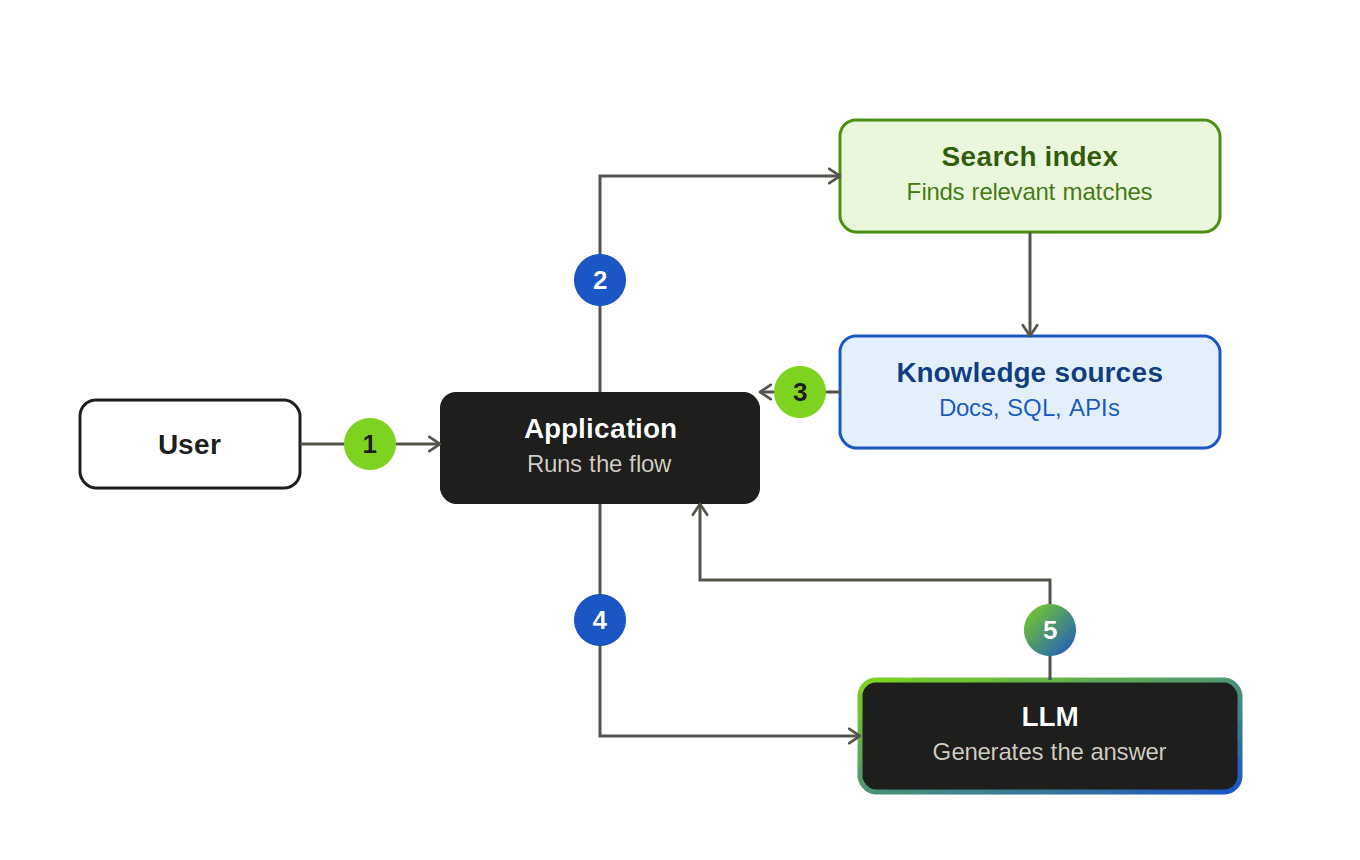
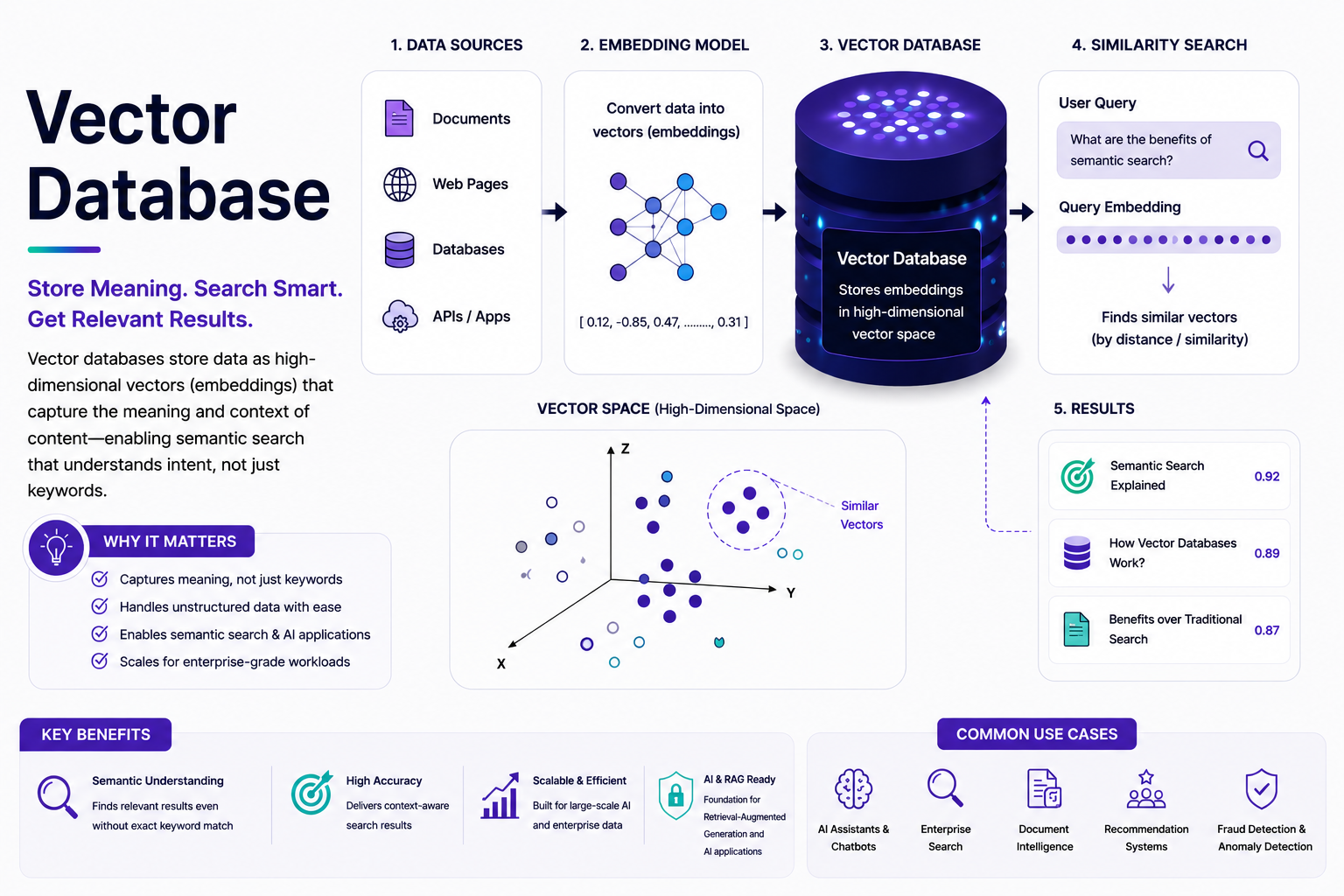
- Building the external knowledge base. Data from outside the model's original training set, sourced from APIs, databases, or document stores, gets converted into a searchable format. Using embedding models, this content (files, records, unstructured text, whatever form it takes) is transformed into numerical vectors and stored in a vector database, creating a structured knowledge library the AI can search efficiently.
- Retrieving relevant content. When a user submits a query, it's likewise converted into a vector and compared against the vector database to find the closest matches. Picture an internal HR chatbot: an employee asks how many vacation days they have left, and the system pulls both the company's leave policy and that employee's personal leave history, because both are mathematically determined to be highly relevant to the question asked.
- Enriching the prompt. The retrieved information is then merged with the user's original question to build an augmented prompt. Careful prompt design here ensures the LLM can make full use of the added context to produce a precise, well-grounded answer.
- Keeping the knowledge base current. Data doesn't stay accurate forever, so the underlying knowledge source needs regular upkeep, whether through real-time syncing or scheduled batch updates, along with refreshed embeddings. This is the same kind of ongoing data-maintenance challenge familiar from broader data analytics work, and it can be handled with a range of existing data-management strategies.
Frequently Asked Questions
RAG stands for Retrieval-Augmented Generation, a method that pairs an LLM with an external retrieval system so responses draw on up-to-date, authoritative data instead of relying solely on the model's training.
Fine-tuning retrains a model on new data, which is costly and time-consuming. RAG instead retrieves relevant information at query time and feeds it into the prompt, leaving the underlying model untouched while still improving accuracy.
RAG significantly reduces the risk of fabricated answers by grounding responses in retrieved, verifiable content, though it doesn't guarantee elimination entirely since output quality still depends on retrieval accuracy and prompt design.
RAG can pull from virtually any structured or unstructured source, internal documents, databases, APIs, live news feeds, or social media, as long as that data can be indexed and converted into a searchable vector format.
Turn this insight into your next move.
Tell us what you're building and we'll show you where uCube.ai actually fits — no generic demo, just a straight conversation about your data and your goals.