

AI & Data Fundamentals
What Is a Vector Database? A Complete Guide
What Is a Vector Database?
A vector database is a system built to store, index, and search high-dimensional numerical representations of data, known as vector embeddings. Instead of organizing information into rows and columns the way a traditional relational database does, a vector database places each piece of data as a point in a multi-dimensional space, where distance and direction between points reflect how similar or different those pieces of data are.
This matters because most of the data organizations generate today, text, images, audio, video, doesn't fit neatly into a predefined schema, and searching it by exact keyword match misses the point entirely. A search for "laptop" in a traditional system won't surface a document about a "notebook computer" unless that exact phrase appears. A vector database, by contrast, can recognize that the two concepts are closely related because their embeddings sit near each other in vector space, even though they don't share a single word.
Why Vector Databases Matter
The rise of large language models and generative AI has made this kind of similarity-based retrieval essential rather than optional. Most AI applications, from chatbots to recommendation engines, need to find relevant information quickly across enormous, unstructured datasets, and they need to find it based on meaning rather than surface-level text matching.
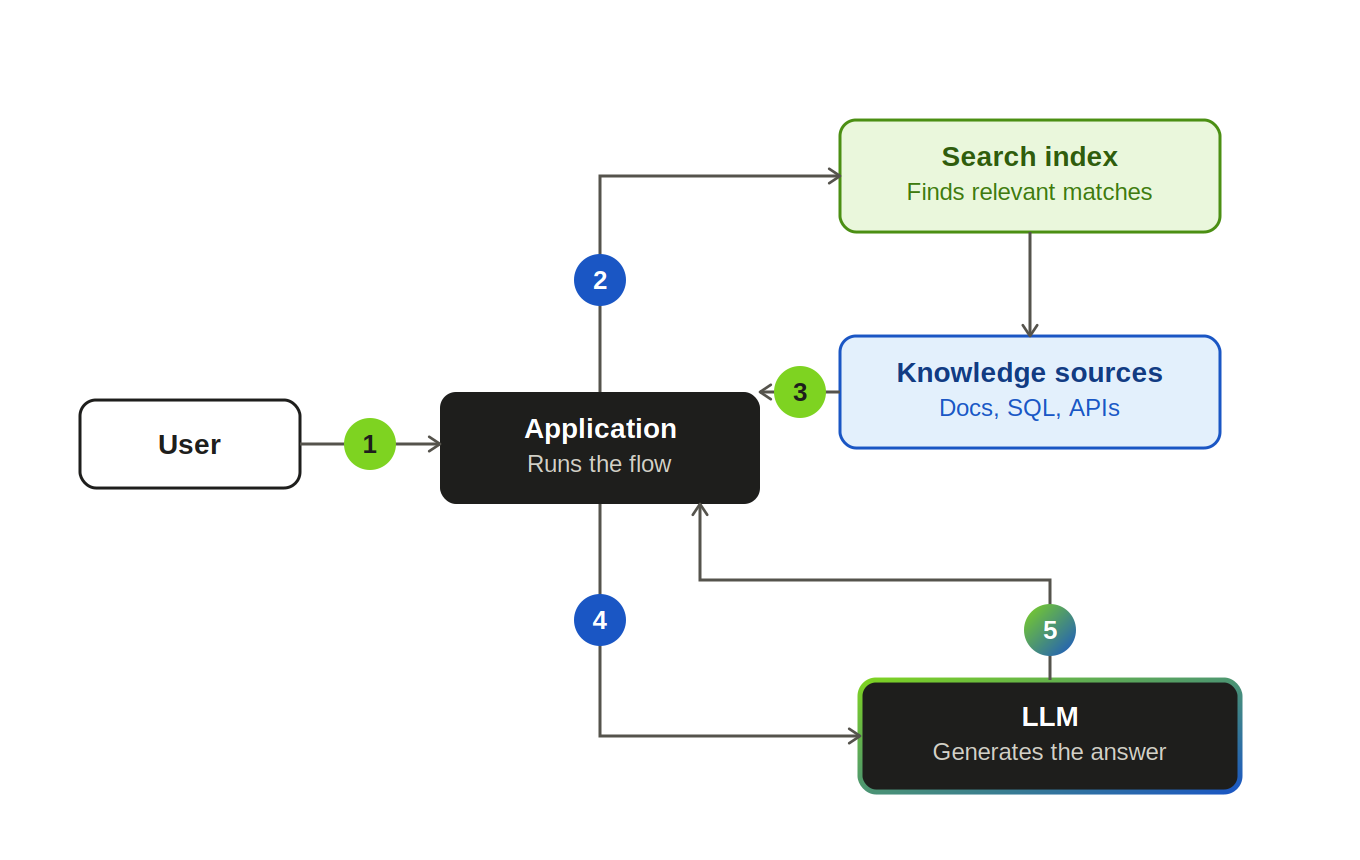
Vector databases are also the backbone of retrieval-augmented generation, or RAG, an approach where a model's response is grounded in real, retrieved content rather than generated purely from what the model memorized during training. By pulling relevant, verified passages into the prompt at query time, a vector database helps reduce hallucination and gives users a way to trace an answer back to its source.
Core Concepts: Vectors and Embeddings
A vector, in this context, is simply an ordered list of numbers, where each number represents some learned characteristic of a piece of data. A short list of numbers might describe a single word; a longer one might capture the meaning of an entire paragraph, image, or audio clip. The number of values in that list is referred to as the vector's dimensionality, and it can range from a few dozen to several thousand depending on how much nuance the underlying model needs to capture.
An embedding is the process, and the result, of converting raw content into one of these vectors using a trained machine learning model. The model learns to place similar concepts near each other in vector space and dissimilar concepts farther apart. Two words with related meanings, like "car" and "vehicle," end up with vectors that sit close together, even though the words themselves look nothing alike. That's what makes semantic, meaning-based search possible.
How Vector Databases Work
Vector databases generally handle three core functions:
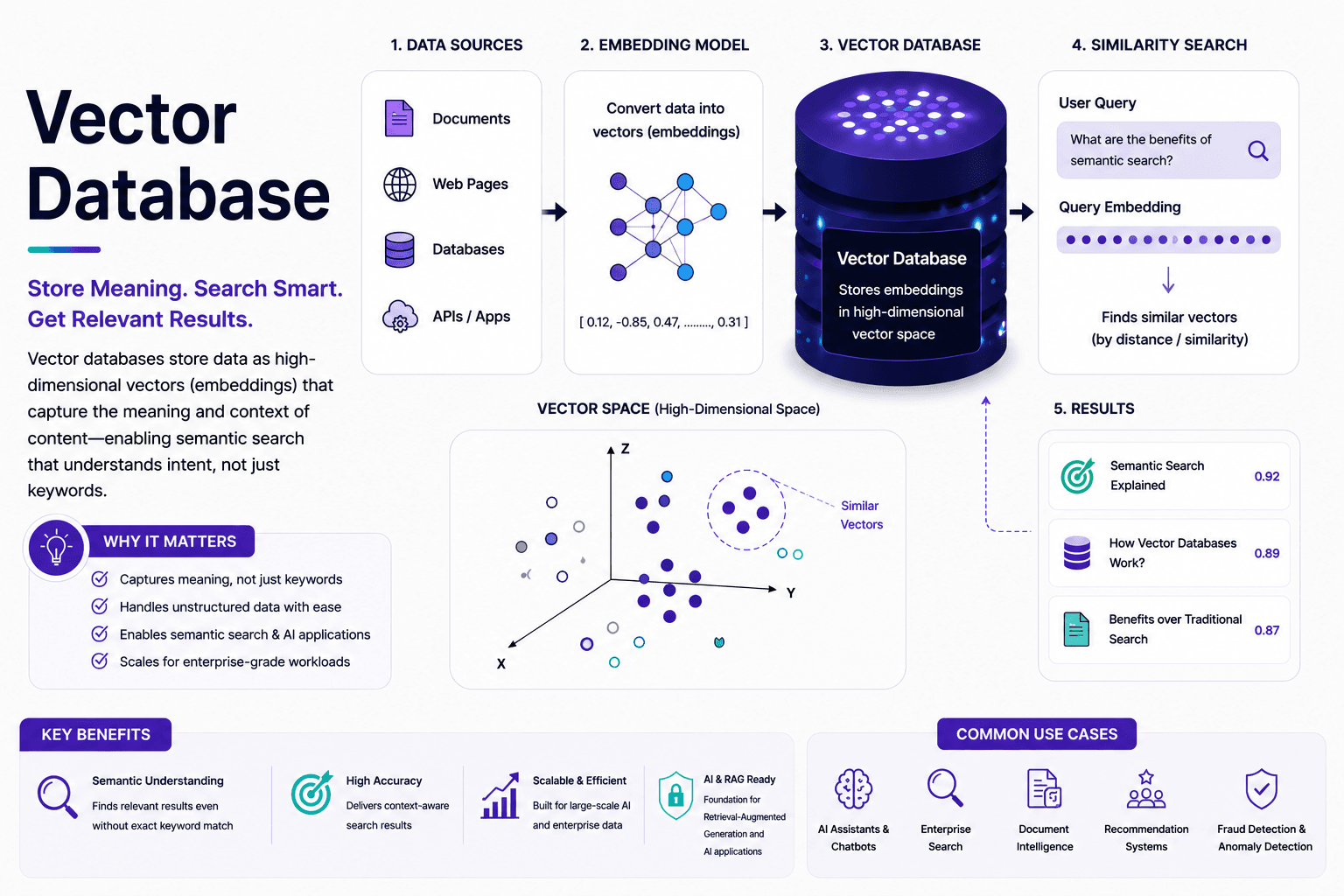
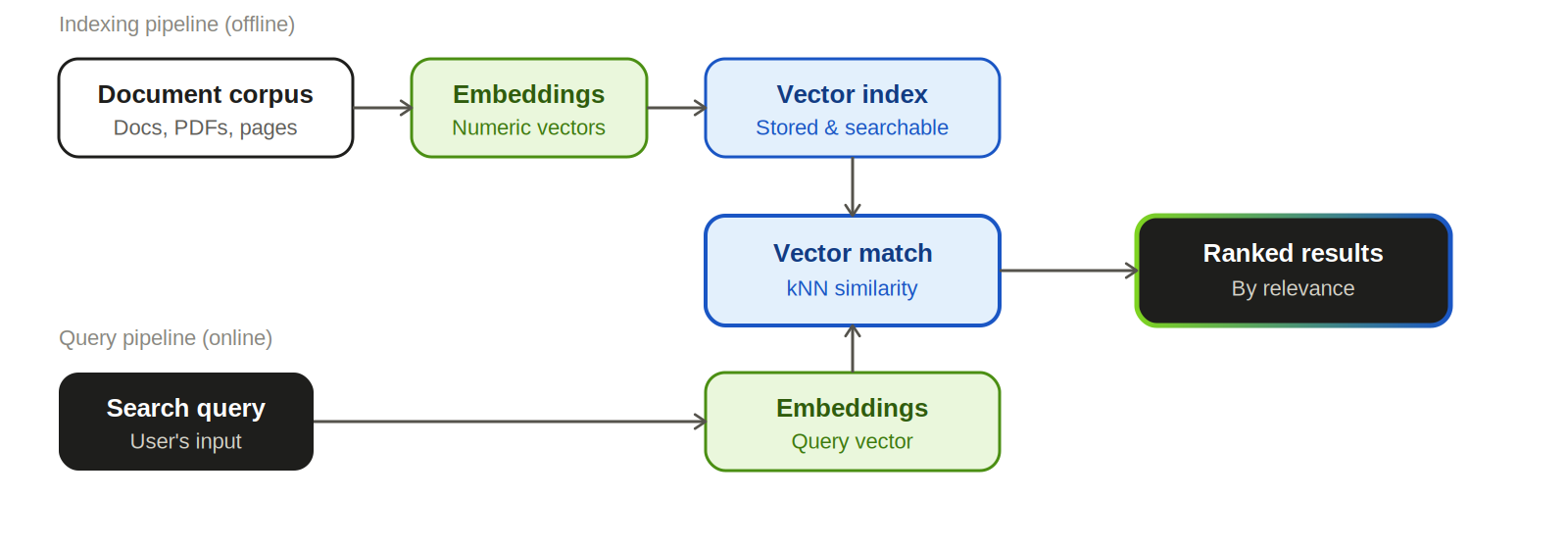
- Storage. Embeddings are generated ahead of time and stored alongside metadata, such as a title, source, or category, so they don't need to be recomputed every time a query comes in.
- Indexing. Because comparing a query against every stored vector one by one would be far too slow at scale, vector databases build specialized index structures that make it possible to find the closest matches without scanning the entire dataset. Common approaches include graph-based methods and hashing-based methods, both designed to approximate the nearest neighbors quickly rather than guarantee a perfect exhaustive match.
- Search. When a query comes in, it's converted into its own vector using the same embedding model, then compared against the indexed vectors using a similarity or distance measure, such as cosine similarity or Euclidean distance. The database returns the closest matches, typically in milliseconds even across very large collections.
Many vector databases also support hybrid search, combining vector similarity with traditional metadata filters, so a query can ask for content that's both semantically similar and, for example, published within a specific date range or category.
Types of Vector Databases
- Purpose-built vector databases — dedicated systems designed from the ground up around vector storage and search, offering the deepest feature set for this specific workload.
- Vector extensions for existing databases — add-ons for established relational or document databases that bring vector similarity search into a system teams already run, combining familiar tooling with new retrieval capabilities.
- Search engines with vector support — platforms originally built for full-text search that have added vector indexing, useful for teams that want to combine keyword and semantic search in one system.
- Vector capabilities within data platforms — vector storage and search integrated directly into a broader data lakehouse or data platform, reducing the need to move data into a separate system.
- Serverless vector databases — managed offerings that scale automatically with query volume and data size, removing the need to provision or manage infrastructure directly.
Vector Databases vs. Traditional and Graph Databases
Traditional relational databases are built around structured schemas and exact-match queries; they're excellent at answering questions like "show me every order placed last week" but aren't designed to find content that's conceptually similar rather than identical. Vector databases fill that gap by representing meaning geometrically, so relatedness can be measured as distance rather than defined manually in advance.
Graph databases solve a different problem. Where a vector database organizes data by similarity, a graph database organizes data by explicit relationships, representing entities as nodes and their connections as edges. Graph databases shine when the connections between data points matter as much as the data itself, such as mapping relationships between people, accounts, or systems, while vector databases shine when the goal is finding content that means something similar, even if it's never been explicitly linked.
Common Use Cases
- Retrieval-augmented generation — grounding LLM responses in real, retrieved enterprise content to reduce hallucination and improve traceability.
- Conversational AI and enterprise search — helping chatbots and search tools surface relevant answers from large knowledge bases, along with the source material behind them.
- Recommendation engines — suggesting products, videos, or content based on similarity to what a user has previously viewed or purchased.
- Image and multimedia search — finding visually or acoustically similar content, such as matching a photo to similar product images.
- Anomaly and fraud detection — identifying data points that fall far outside normal clusters in vector space, which can signal unusual or fraudulent activity.
Challenges to Plan For
- Data pipeline complexity. Raw content has to be cleaned, chunked, and embedded before it can be stored, which means building and maintaining a reliable ingestion pipeline alongside the database itself.
- Security and governance. Embeddings and their metadata can still carry sensitive information, so access controls, encryption, and data lineage tracking matter just as much as they do for any other enterprise data store.
- Choosing the right workload fit. Vector search excels at fact-based, similarity-driven retrieval, but tasks like broad summarization across an entire corpus are often better served by a different retrieval approach entirely.
- Embedding quality and drift. The usefulness of a vector database depends heavily on the embedding model behind it; a poorly suited model, or one that drifts out of date with new content, will produce weaker search results no matter how well the database itself performs.
Best Practices for Choosing and Using a Vector Database
Match the database type to your existing stack.
If your data already lives in a relational database or data platform, a vector extension or integrated capability may be simpler to adopt than standing up a new, separate system.
Invest in the ingestion pipeline, not just the database.
Plan for how content will be cleaned, chunked, and embedded on an ongoing basis, since a vector database is only as good as the embeddings feeding it.
Use hybrid search where it makes sense.
Combining keyword filters with vector similarity often produces more precise results than relying on similarity search alone, especially for queries with clear structured constraints.
Apply the same governance standards you would to any data store.
Set access controls and track data lineage for embeddings just as you would for the source data they were generated from.
Test retrieval quality directly, not just database performance.
Fast retrieval that returns the wrong content isn't a win; evaluate the relevance of what comes back, not just how quickly it comes back.
Frequently Asked Questions
A vector is simply an ordered list of numbers. A vector embedding is the specific kind of vector produced by a machine learning model to represent the meaning of a piece of content, like text or an image, so items with similar meaning end up with similar vectors.
No. A vector index is the underlying data structure that makes similarity search fast. A vector database is the broader system built around that index, adding storage, metadata filtering, access control, and other data management features.
Not always. Simple applications can work directly from a model's built-in knowledge or a small amount of context passed in a prompt. Vector databases become important once an application needs to search across a large, unstructured, and frequently changing body of content.
Usually not entirely. Vector databases are built for similarity search, not for the exact-match, transactional workloads relational databases handle well. Many organizations run both, or use a system that combines vector and traditional capabilities together.
Common approaches include cosine similarity, which measures the angle between two vectors, and Euclidean distance, which measures the straight-line distance between them. The right choice depends on the embedding model and the type of data being compared.
Turn this insight into your next move.
Tell us what you're building and we'll show you where uCube.ai actually fits — no generic demo, just a straight conversation about your data and your goals.