

The Agentic Shift: How AI Is Redefining Legal Practice
From single-shot chatbots to reasoning systems built for precedent, evidence, and judgment — a practitioner’s guide to deploying AI across in-house counsel, regulatory, transactional, and litigation functions.
Executive Summary
Legal work has always been an exercise in synthesizing knowledge under pressure — precedent, statute, contract language, and institutional memory, applied to a specific set of facts. What’s changed is the volume and velocity of that knowledge, and increasingly, the tools available to reason through it.
Most organizations experimenting with AI in legal have started with general-purpose chatbots or single-step retrieval systems. These tools are useful for quick lookups, but they were never built for the way lawyers actually think: breaking a question into sub-issues, weighing competing authorities, tracing how a precedent has evolved, and building a conclusion that can be defended, not just generated.
This paper makes the case for a different architecture — agentic AI — where a system decomposes a legal question the way an experienced associate would, researches each component independently, validates findings against the firm’s own knowledge base, and produces an explainable, citation-backed answer. It’s a meaningful step beyond retrieval-augmented generation (RAG), and it’s already running in production.
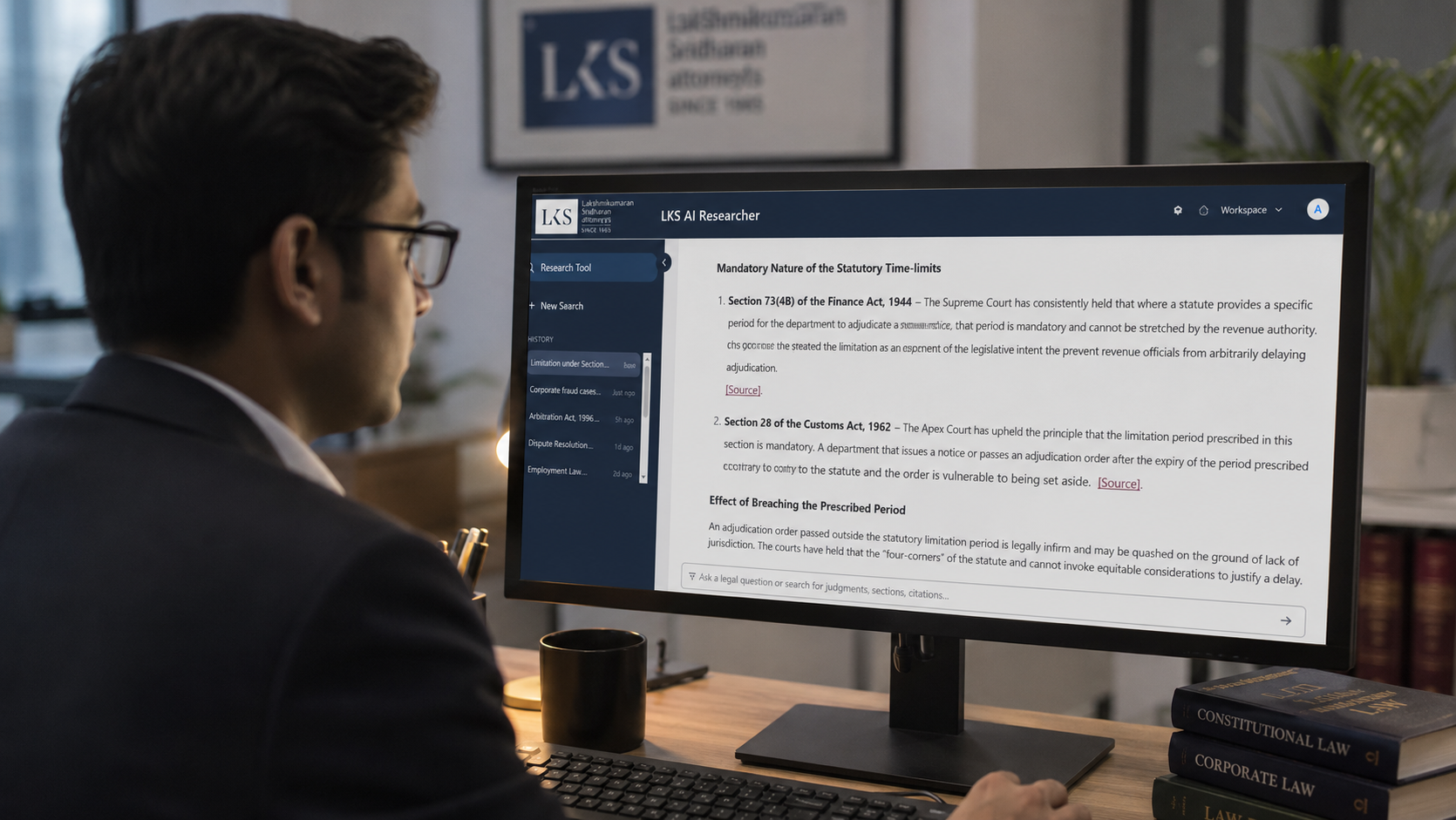
The results referenced throughout this paper come from a real, firmwide deployment at Lakshmikumaran & Sridharan, one of India’s leading full-service law firms, built on uCube.ai’s CortX platform. What follows is a practical breakdown of the problem, the architecture that addresses it, and a framework legal teams can use to evaluate and adopt agentic AI themselves.
Who this is for: General counsel, managing partners, legal operations leaders, and innovation teams evaluating how AI fits into research, contract work, regulatory monitoring, and litigation support — without compromising the rigor legal work demands.
The Legal Industry at an Inflection Point
Regulatory complexity is compounding, judicial precedent is expanding, and clients expect faster, more precise answers. Competitive advantage now depends less on access to information and more on how quickly an organization can synthesize and apply it.
Three forces are converging on legal teams at once. First, the sheer volume of statutes, rulings, and regulatory updates that a firm or in-house team needs to track has outpaced what manual research can keep up with, particularly across multiple jurisdictions. Second, institutional knowledge — the years of memos, opinions, and matter history that make a firm’s advice distinctive — largely sits locked away in document management systems, searchable only by whoever happens to remember where to look. Third, clients and business stakeholders increasingly expect legal answers on the timeline of a product team, not a research team.
The instinct in response has often been to treat AI as an automation layer — a way to do the same research faster. That framing undersells what’s actually possible. The firms getting real value from AI aren’t just accelerating old workflows; they’re treating their accumulated expertise as a strategic asset that AI can make accessible at scale, without diluting the judgment that sits on top of it.
What legal teams are actually trying to solve
Knowledge trapped in silos
Decades of research, memos, and precedent exist, but aren’t searchable in a way that reflects how lawyers actually reason.
Research bottlenecks
Routine questions — comparing statutes, verifying citations, checking a clause against a playbook — consume disproportionate senior time.
Rising jurisdictional complexity
Cross-border matters and shifting regulation demand research depth that doesn’t scale linearly with headcount.
Client expectations
Internal and external clients expect faster turnaround without a drop in the rigor or defensibility of the answer.
The strategic reframe: AI in legal isn’t about replacing judgment — it’s about making four decades of institutional expertise instantly accessible to every lawyer, on every matter, from day one.
Why Generic AI Falls Short in Legal Work
Off-the-shelf chatbots and conventional retrieval-augmented generation (RAG) systems retrieve information and generate a response in a single step. That’s a fundamentally different process from how legal reasoning actually works — and the gap shows up exactly where it matters most.
A general-purpose chatbot answers a question by predicting plausible-sounding text. A conventional RAG system improves on this by first retrieving a handful of relevant documents, then generating an answer grounded in them. Both approaches treat the question as a single unit — one retrieval pass, one generation pass, done.
Legal questions rarely work that way. Ask a lawyer whether a proposed contract term is enforceable in a given jurisdiction, and they don’t retrieve one document and summarize it — they break the question into parts (which statute governs, has it been amended, how have courts interpreted the relevant clause, does a conflicting precedent exist), research each part, weigh the strength of competing authorities, and only then compose an answer they’re willing to put their name on.
Hallucinated authority
Single-pass generation can produce fluent citations to cases or statutes that don’t exist, or that don’t say what the model claims.
Shallow retrieval
Keyword or basic similarity search misses semantically relevant precedent that doesn’t share the same vocabulary.
No confidence signal
A flat answer gives no sense of how strong the supporting authority actually is, or whether it’s been overturned.
Limited explainability
Without a visible reasoning chain, a lawyer can’t audit how the system reached its conclusion before relying on it.
None of this means the underlying models are the problem. It means the architecture wrapped around them needs to match the way legal reasoning is actually structured — multi-step, evidence-weighted, and traceable back to source. That’s the gap agentic AI is built to close.
The Agentic AI Approach
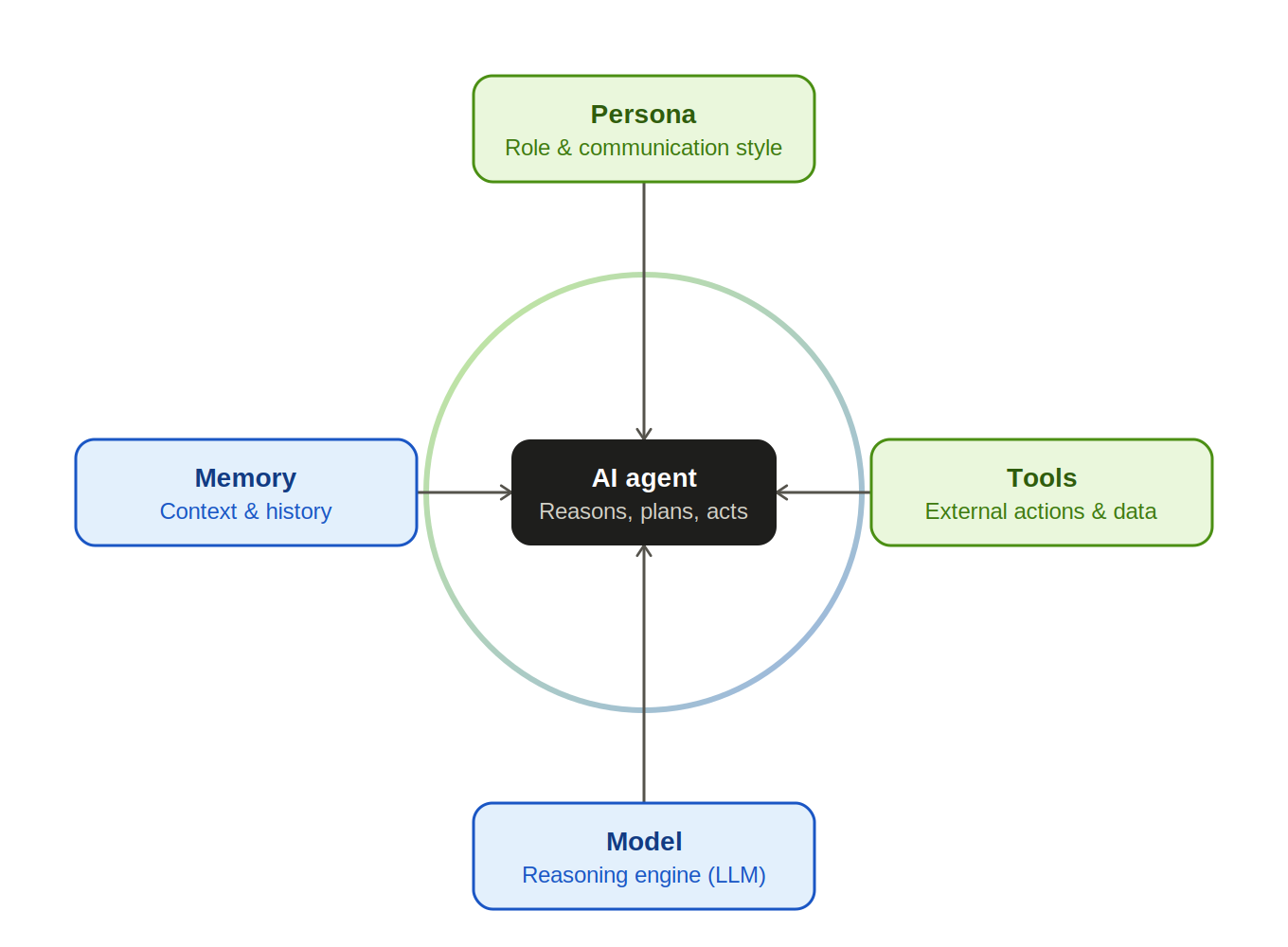
Agentic AI doesn’t retrieve and generate in one pass. It decomposes a legal question into a chain of research tasks, gathers and validates evidence across sources, reasons through competing authorities, and synthesizes a conclusion grounded in the organization’s own knowledge base — with every step visible and auditable.
- 1
Agentic Deep Research
Complex legal questions are broken into a chain of reasoning steps. AI agents independently research, validate, and synthesize findings for each step before composing a final answer — mirroring how an experienced associate would approach the same question.
- 2
Knowledge Graph & Confidence Scoring
Relationships between precedents, statutes, legal concepts, and prior advisory work are modeled as a graph, not a flat index. Each supporting authority is assigned an issue-based confidence score, so lawyers can see how strong the ground beneath an answer really is.
- 3
Hybrid Retrieval & Graph Reasoning
Vector search is combined with graph-based reasoning to surface authorities that are contextually relevant, not just lexically similar — catching precedent a keyword search would miss entirely.
- 4
Citation Intelligence
Forward and backward citation analysis lets lawyers trace how a precedent has evolved, validate its current strength, and confirm it hasn’t been narrowed or overturned — before it goes into a brief or a memo.
- 5
Explainable & Secure by Design
Every insight is source-backed, traceable, and auditable, governed through enterprise-grade access controls — so the system’s reasoning can be checked, not just trusted.
The distinction that matters: a single-step system answers a question. An agentic system shows its work — and in legal, being able to check the work is often the whole point.
From Research Tool to Firmwide Intelligence Layer
The most consequential shift isn’t technical, it’s organizational. Framed correctly, agentic AI stops being “a tool lawyers use” and becomes the layer through which a firm’s collective expertise is made available to every matter, every day.
That reframing has practical consequences for how a deployment is scoped. A research tool is judged on whether individual users like it. An intelligence layer is judged on whether it changes how the organization works — whether junior associates reach senior-quality research faster, whether institutional knowledge from retired partners stays usable, whether the firm can take on more complex matters without proportionally more headcount.
Getting there requires more than plugging a model into a document repository. It requires the knowledge graph and confidence scoring layer described above, security and access controls that satisfy the confidentiality standards legal work demands, and — critically — a deployment process that earns trust incrementally rather than asking lawyers to take the system’s word for it on day one.
The next section walks through where this plays out in practice — across in-house counsel, regulatory, transactional, and litigation functions, each with a distinct set of everyday problems that agentic AI is built to solve.
Where AI Creates Value Across the Legal Function
The specific workflow changes by function, but the pattern repeats: routine information discovery gets automated, freeing lawyers to spend more time on judgment, strategy, and advocacy.
| Function | Everyday Challenge | Where Agentic AI Helps |
|---|---|---|
| In-House Counsel | High-volume routine inquiries and vendor paper pull senior time away from strategic work. | Instant jurisdiction-aware research, first-pass memos on routine questions, and automated audit of supplier agreements and NDAs against risk thresholds. |
| Regulatory | Tracking fast-moving regulatory change across multiple jurisdictions and mapping impact to the business. | Real-time horizon scanning, jurisdictional comparison, gap analysis against internal policy, and simulation of the operational impact of proposed rules. |
| Transactional | Diligence on data rooms with thousands of unstructured documents under deal-timeline pressure. | Bulk extraction of key liabilities and change-of-control provisions, auto-generated deal chronologies, and citation verification during drafting. |
| Litigation | Building a fact pattern and legal argument from thousands of pleadings, exhibits, and correspondence. | Auto-generated event timelines, targeted fact discovery across case files, and research to support motion and brief drafting. |
A common thread
In every function, the highest-value use of AI isn’t answering the hardest questions outright — it’s clearing away the volume of routine, well-defined work that currently consumes disproportionate time from people qualified to do much more. The lawyer’s judgment moves earlier in the process, not out of it.
What Changes Day-to-Day
Beyond the function-level breakdown, three concrete shifts tend to show up quickly once agentic AI is embedded into daily workflows.
- A
Research shifts from hours to minutes
Natural-language queries across the firm’s own knowledge base replace manual document-by-document search, without giving up citation-backed accuracy.
- B
Institutional knowledge becomes reusable
Work product from years or decades ago — memos, opinions, negotiated positions — becomes searchable and applicable to new matters instead of sitting dormant.
- C
Senior time reallocates toward judgment
As routine discovery gets automated, partners and senior counsel spend a larger share of their time on strategy, negotiation, and client advisory — the work that’s hardest to automate and most valuable to clients.
Why this matters for the bottom line: reallocating senior time from information discovery to advisory work doesn’t just improve margins — it changes what clients are paying for.
Case in Point: Lakshmikumaran & Sridharan
One of India’s leading full-service law firms partnered with uCube.ai to turn more than four decades of institutional knowledge into a firmwide AI legal intelligence platform — deployed and fine-tuned over nine months, then rolled out across all tax groups.
“Great institutions progress because they find ways to carry their wisdom forward, even as the world changes around them. For us, AI isn’t about automating legal practice. It’s about making better use of everything we’ve learned over the years.
L Badri Narayanan — Executive Partner, Lakshmikumaran & Sridharan
Rather than deploying AI as a bolt-on assistant, the firm built a firmwide intelligence layer — combining agentic deep research, a knowledge graph with confidence scoring, hybrid retrieval, and citation intelligence, all governed under enterprise-grade security. The result: lawyers spend less time on manual discovery and more time on the legal judgment, strategy, and client advisory that define the practice.
Why It Resonated
“uCube.ai really took the time to understand how lawyers actually work. As a result, their solution has quickly been adopted across the firm because it resonates with how lawyers naturally work.
Sriram Sridharan — Senior Partner, Lakshmikumaran & Sridharan
The adoption numbers are the headline, but the more durable outcome is structural: the firm now has a scalable foundation it can extend as practice needs evolve, rather than a point solution tied to a single use case. Three outcomes stand out:
Institutional knowledge reuse
Four decades of expertise made searchable firmwide, instead of living in the memory of a handful of senior partners.
Accelerated research
Natural-language search materially reduces time spent on manual, routine discovery work.
Higher-value legal work
Automating information discovery frees lawyers to focus on strategic analysis and client advisory.
A foundation for what’s next
A scalable base the firm can extend into new workflows as practice needs evolve.
Security, Governance & Trust
Legal work carries a confidentiality standard that most enterprise AI deployments don’t have to meet. Any platform handling privileged material needs to be secure and auditable by design, not as an afterthought.
Encryption at rest and in transit
Data is encrypted throughout its lifecycle, from ingestion through storage and retrieval.
Data residency options
Hosting available across multiple regions to meet local regulatory and client requirements.
Zero-training on client data
Proprietary matter data never trains the underlying base models — it stays cryptographically isolated in a dedicated, air-gapped vault.
Enterprise-grade access control
Every insight is traceable and auditable, governed through role-based access and security frameworks suited to legal confidentiality standards.
Why this can’t be an afterthought: the same explainability that makes an agentic system trustworthy for legal reasoning — a visible, traceable chain of evidence — is also what makes it auditable for security and governance. The two are built on the same foundation.
A Framework for Adoption
Firms that succeed with agentic AI tend to follow a similar path: start narrow, prove value on a real workflow, then expand deliberately rather than attempting a firmwide rollout on day one.
- 1
Assess
Identify the practice group and workflow where research volume and time pressure are highest, and where institutional knowledge is most underused today.
- 2
Pilot
Deploy against a defined use case with a small group of lawyers, fine-tuning the knowledge graph and confidence scoring against real matters and real feedback.
- 3
Validate
Measure adoption and research quality directly with the pilot group before expanding — trust in legal tools is earned incrementally, not assumed.
- 4
Scale
Extend the platform firmwide once the pilot demonstrates measurable time savings and lawyer confidence in the outputs, following the pattern set during the pilot.
- 5
Govern
Formalize access controls, audit processes, and ongoing evaluation so the platform remains a trusted layer of the practice, not a static tool that ages out of relevance.
The nine-month deployment timeline at Lakshmikumaran & Sridharan reflects this discipline — enough time to fine-tune the system against real matters before asking the full firm to rely on it.
The Road Ahead
The firms moving fastest on legal AI aren’t the ones with the flashiest chatbot. They’re the ones treating their own accumulated expertise as an asset worth making accessible — and building the architecture to do it responsibly.
As regulatory complexity continues to compound and client expectations keep rising, the gap between firms that can synthesize knowledge at scale and those that can’t will only widen. Agentic AI, grounded in an organization’s own knowledge graph and governed with the rigor legal work demands, is becoming the mechanism that closes that gap.
The technology will keep evolving — deeper reasoning chains, richer knowledge graphs, tighter integration with matter management and document systems. But the underlying principle is likely to hold: the value isn’t in automating legal practice, it’s in making decades of institutional judgment usable by every lawyer, on every matter, starting now.
This paper reflects uCube.ai’s work with legal teams as of July 2026 and draws on a production deployment at Lakshmikumaran & Sridharan. For a deeper walkthrough of the CortX architecture or to discuss a specific workflow, reach out to the uCube.ai team.
Ready to see agentic AI on your own matters?
uCube CortX brings agentic research, knowledge graphs, and citation intelligence to your firm’s own documents — deployed with the security and governance legal work requires.